

New 2025 JN0-649 exam questions Welcome to download the newest TestsDumps JN0-649 PDF dumps (195 Q&As)
P.S. Free 2025 JNCIP-ENT JN0-649 dumps are available on Google Drive shared by TestsDumps
NEW QUESTION # 55
When using wide metrics, which two statements about route advertisement between IS-IS levels are correct?
(Choose two.)
- A. Level 1 routes are advertised to Level 2 routers by default.
- B. If wide-metrics-only is configured, Level 1 routes are not advertised to Level 2 routers by default.
- C. Level 1 and Level 2 routers do not advertise Level 2 routes into the Level 1 area by default.
- D. Level 1 routes advertised as external routes into Level 1 are not advertised to any Level 2 routers by default.
Answer: C,D
NEW QUESTION # 56
Referring to the exhibit, on which three IS-IS routers will the attached bit be set? (Choose three.)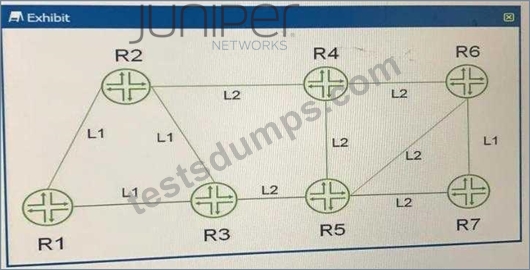
- A. R6
- B. UR3
- C. R4
- D. UR5
- E. R2
Answer: A,B,E
NEW QUESTION # 57
A customer on MSTI-2 was isolated due to a physical link outage on Switch 5's ge-0/0/32 interface.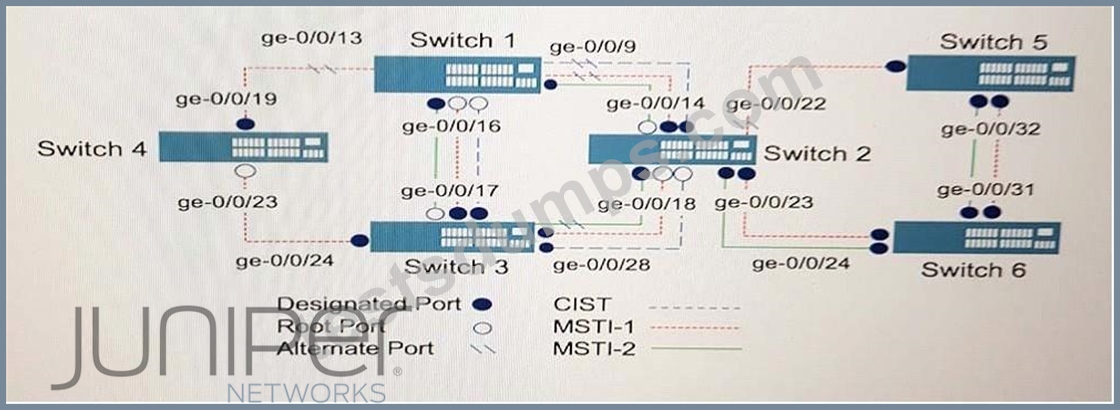
Referring to the exhibit, which corrective action would solve this problem?
- A. Move the root bridge for MSTI-2 to Switch 6.
- B. replace the link between Switch 5 and 6 with a 10 Gbps link
- C. Add MSTI-2 to all interfaces on Switch 5.
- D. Implement the CIST on all switches.
Answer: C
NEW QUESTION # 58
BGP multipath or multihop are not configured in your network. In this scenario, what is the correct sequence for BGP active route selection?
- A. higher local preference
shortest AS path
lowest router ID
lowest peer address
lower origin code - B. higher local preference
shortest AS path
lowest peer address
lowest router ID
lower origin code - C. higher local preference
shortest AS path
lower origin code
lowest router ID
lowest peer address - D. higher local preference
lowest router ID
lowest peer address
lower origin code
shortest AS path
Answer: C
Explanation:
BGP Path Selection process follows this order
1.Weight (Bigger is better)
2. Local preference (Bigger is better)
3. Self originated (Locally injected is better than iBGP/eBGP learned)
4. AS-Path (Smaller is better)
5. Origin
6. MED (Smaller is better)
7. External (Prefer eBGP over iBGP)
8. IGP cost (Smaller is better)
9. EBGP Peering (Older is better)
10. Router- ID
http://www.next-itsolutions.co.uk/wp-content/uploads/2015/09/CCIE-BGP-Best-Path- Selection1.png
https://www.juniper.net/documentation/us/en/software/junos/vpn-l2/bgp/topics/concept/routing- protocols-address-representation.html
NEW QUESTION # 59
You are asked to deploy 802.1X on your EX Series switches. You need to ensure authenticated devices continue to have access to the network even if the authentication server fails.
Which action meets this configuration objective?
- A. Configure the static MAC bypass for the authentication server.
- B. Set the reauthentication interval to a value of 0.
- C. Set the reauthentication interval to a value of disable.
- D. Configure the server fail fallback with a value of sustain.
Answer: D
Explanation:
https://www.juniper.net/documentation/us/en/software/junos/user-access/topics/concept/802-1x- pnac-divert-authentication-understanding-mx-series.html
NEW QUESTION # 60
You are deploying IP phones in your enterprise networks. When plugged in, the IP phones must automatically negotiate the power requirements for the new connection with the EX Series switches. In this scenario, which protocol should be used to enable this behavior?
- A. CDP
- B. LLDP
- C. LLDP-MED
- D. MP-BGP
Answer: C
NEW QUESTION # 61
Click the Exhibit.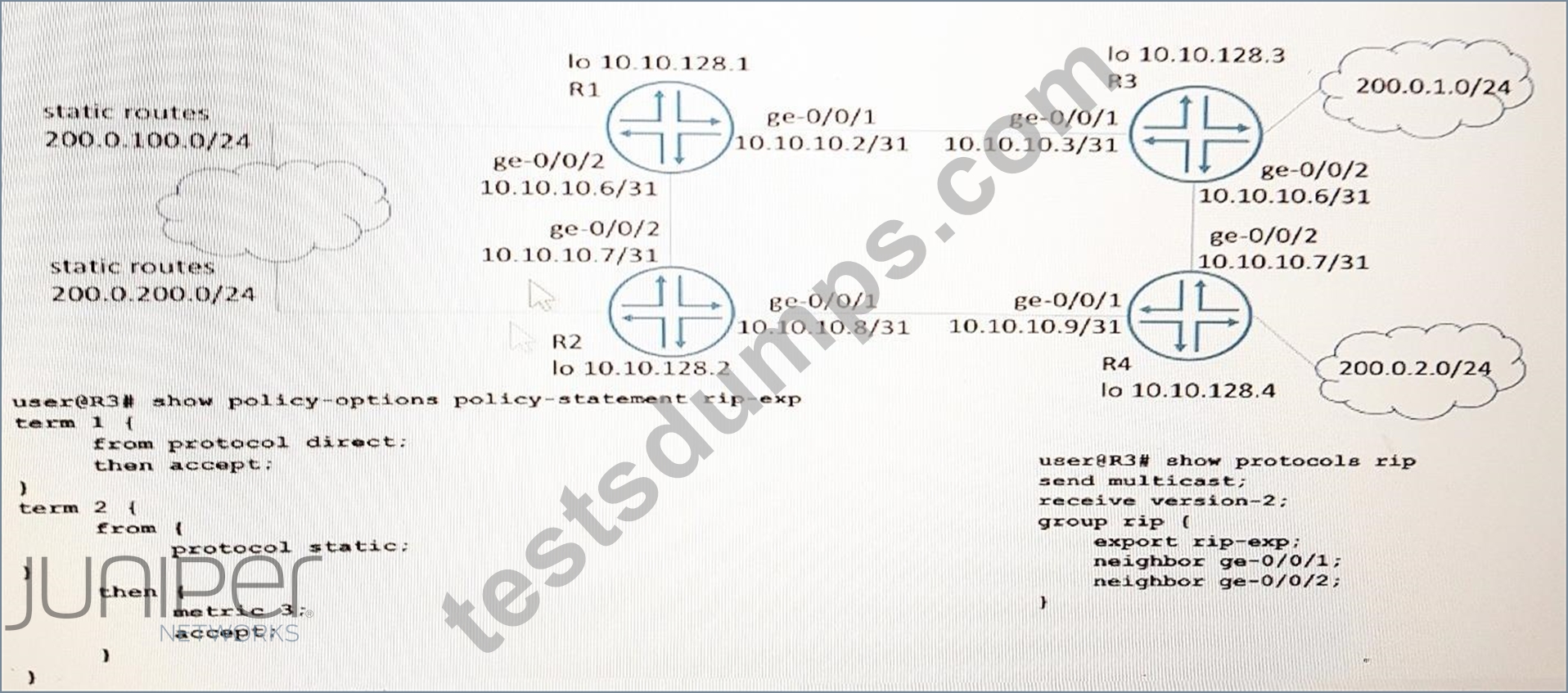
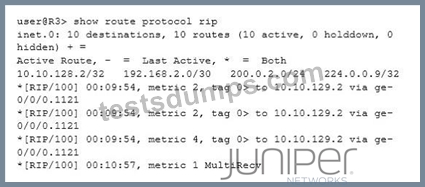
The ping command shows that connectivity of the 200.0.1/24 network to the 200.0.200.0/24 network exists. You notice that all the ping test results from various devices on 200.0.1.0/24 follow the same path even through equal cost paths exist to the 200.0.200.0/24 network.
Referring to the exhibit, what is happening?
- A. RIPv2 does not support load balancing static routes.
- B. The RIP group must include the preference statement.
- C. The rip-exp policy needs to be modified to advertise RIP routes
- D. Load balancing needs to be enabled for equal cost pathing to work.
Answer: D
NEW QUESTION # 62
Which two statements are correct about the deployment of EVPN-VXLAN on QFX Series devices? (Choose two.)
- A. Junos OS supports underlay replication for BUM traffic forwarding.
- B. Type 1 route advertisements always have the single-active flag set to 0.
- C. Junos OS supports ingress replication for BUM traffic forwarding.
- D. Type 1 route advertisements always have the single-active flag set to 1.
Answer: B,C
Explanation:
BUM Traffic Forwarding
Junos devices that use MPLS encapsulation for EVPNs can only use ingress replication at this time.
Ingress replication means, to flood traffic to remote PE routers, the traffic has to be replicated, once for each remote PE router.
The EVPN label for this BUM traffic is learned per PE router from the route type 3, inclusive multicast Ethernet tag route.
This table shows the format of the inclusive multicast Ethernet tag route.
All-Active Redundancy (4)
This diagram shows the format of the type 1 route, A-D route per ES. The split horizon label is advertised as part of an extended community attached to the type 1 route. The split horizon label is also called the ESI label. The extended community also indicates what type of redundancy mode is used for this given ESI: single-active represented by binary 1 or active-active represented by binary 0.
NEW QUESTION # 63
You are asked to configure 802.1X on your access ports to allow only a single device to authenticate. In this scenario, which configuration would you use?
- A. single-secure supplicant mode
- B. single supplicant mode
- C. MAC authentication mode
- D. multiple supplicant mode
Answer: B
NEW QUESTION # 64
Which three configuration parameters must match on all switches within the same MSTP region? (Choose three.)
- A. bridge priority
- B. region name
- C. revision level
- D. VLAN to instance mapping
- E. configuration name
Answer: C,D,E
Explanation:
For Multiple Spanning Tree Protocol (MSTP) to operate correctly, all switches in the same region must have the same VLAN to instance mapping, revision level, and configuration name. These parameters ensure that all switches interpret the MSTP configuration consistently.
References:
* MSTP Configuration Guide, Juniper Networks
NEW QUESTION # 65
Referring to the exhibit, which statement is true?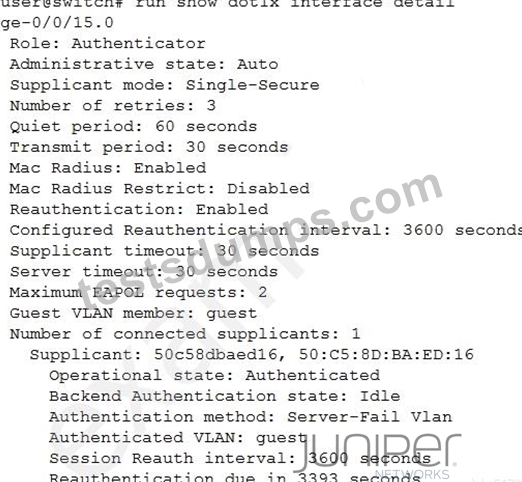
- A. The current device is authenticated using MAC RADIUS
- B. Only 802. 1X authentication will be used for devices connecting to ge-0/0/15
- C. The current device was allowed after authentication attempts to the RADIUS server failed
- D. Additional users will automatically be allowed to connect to ge-0/0/15
Answer: C
NEW QUESTION # 66
You are running OSPF as your IGP. The interfaces connecting two routers are in the ExStart state. You notice that something is incorrect with the configuration.
Referring to the exhibit, which statement is correct?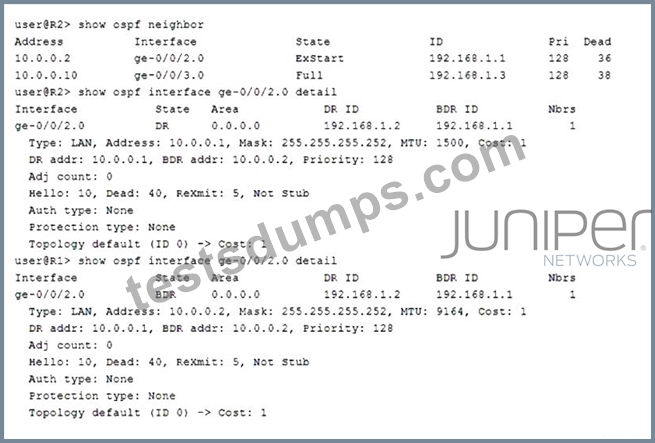
- A. The MTU setting are incorrect.
- B. The subnet mask is incorrect.
- C. The IP addresses are incorrect.
- D. The interface type is incorrect.
Answer: A
NEW QUESTION # 67
Which two port modes are associated with STP? (Choose two.)
- A. root
- B. backup port
- C. designated
- D. alternate port
Answer: A,C
NEW QUESTION # 68
Referring to the exhibit, which statement is true?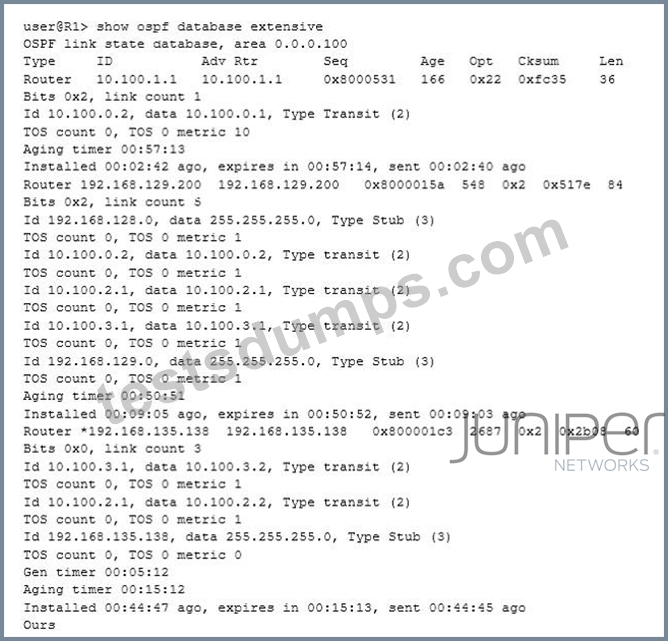
- A. R1 is a backbone router.
- B. R1 is an ASBR.
- C. R1 has the B bit set.
- D. R1 is an ABR.
Answer: B
NEW QUESTION # 69
You are deploying an 802.1X solution and must determine what would happen if clients are unable to re-authenticate to the RADIUS server.
In this scenario, which configuration would provide access to the network if the supplicant is already authenticated?
- A. deny
- B. sustain
- C. move
- D. permit
Answer: B
NEW QUESTION # 70
Referring to the exhibit, you have placed the cos multifield classifier on all edge interfaces and configured the relevant CoS parameters.
In this scenario, which two statements are correct? (Choose two.)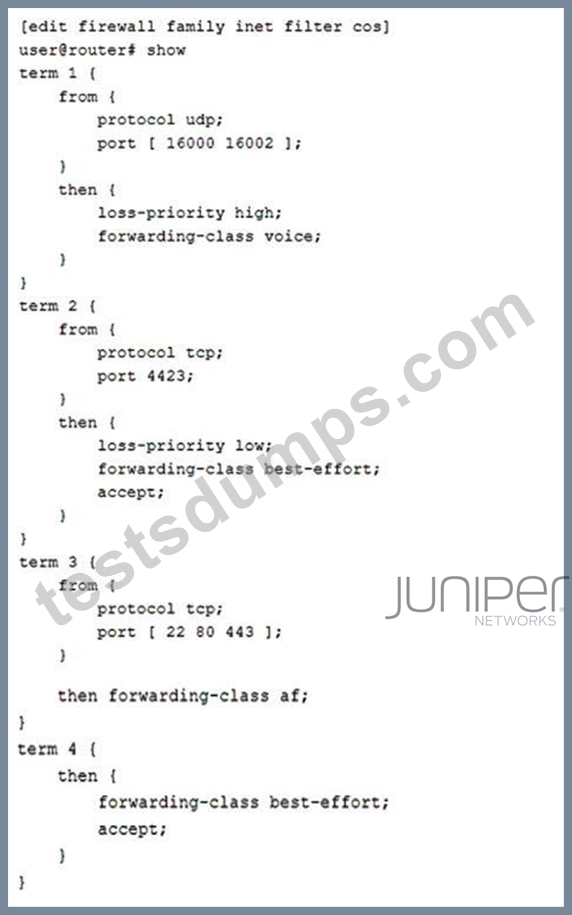
- A. UDP traffic using the 16000 port will be placed in the best-effort forwarding class and accepted.
- B. SSH traffic using the default port will be placed in the best-effort forwarding class and accepted.
- C. SSH traffic using the default port will be placed in the af forwarding class and accepted.
- D. UDP traffic using the 16000 port will be placed in the voice forwarding class and accepted.
Answer: C,D
NEW QUESTION # 71
Which three statements are correct about EVPN route types? (Choose three.)
- A. Type 2 routes carry endpoint MAC address information.
- B. Type 2 routes carry endpoint IP address information.
- C. Type 1 routes carry endpoint MAC address information.
- D. Type 3 routes carry replication information.
- E. Type 5 routes carry replication information.
Answer: A,B,D
Explanation:
The EVPN control plane advertises the following types of information:
Route type 1 - This is an Ethernet Auto-Discovery (EAD) route type used to advertise Ethernet segment identifier, Ethernet Tag ID, and EVPN instance information. EAD route advertisements may be sent for each EVPN instance or for each Ethernet segment.
Route type 2 - This advertises endpoint reachability information, including MAC and IP addresses of the endpoints or VTEPs.
Route type 3 - This performs multicast router advertisement, announcing the capability and intention to use ingress replication for specific VNIs.
Route type 4 - This is an Ethernet Segment route used to advertise the Ethernet segment identifier, IP address length, and the originating router's IP address.
Route type 5 - This is an IP prefix route used to advertise internal IP subnet and externally learned routes to a VXLAN network.
NEW QUESTION # 72
You are deploying IP phones to a customer site. The IP phones will be installed to share a common access port with the user's desktop computer. You are required to provide a mechanism to place user data traffic and voice traffic in different VLANs for class-service application How would you implement this solution?
- A. Apply a multifield classifier on the access ports that assigns voice packets to the assured forwarding class, based on the IP phone manufacturer's MAC QUI
- B. Configure the IP phones to label voice traffic with the DSCP of code point and apply a BA classifier to the access ports to classify voce traffic
- C. Configure flexible VLAN tagging on the user ports with the data and voice VLANs as members
- D. Configure VLAN tagging on the IP phones and use the voice VLAN feature on the access ports to assign lagged frames to the voice VLAN and untagged frames to a data VLAN
Answer: D
NEW QUESTION # 73
Referring to the exhibit, which LSA type is used to advertise 192.168.1.0/24 to R5?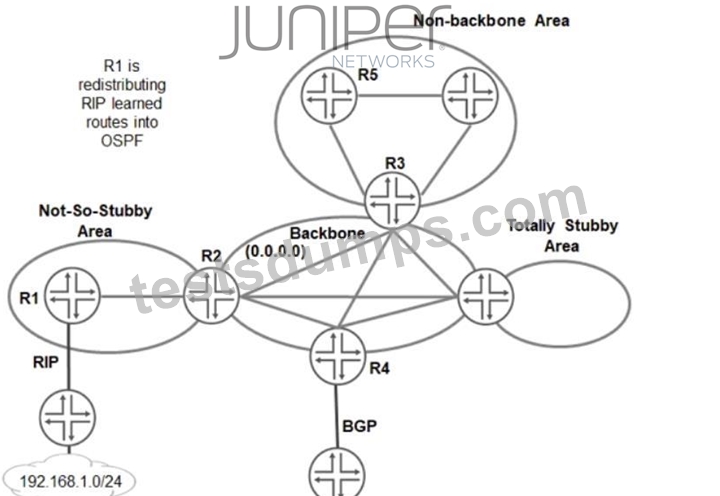
- A. Type 3
- B. Type 4
- C. Type 7
- D. Type 5
Answer: D
Explanation:
Area-1 has no external connections. However, Area-1 has static route (172.16.31.0/24) that are not internal OSPF route. You can limit the external route advertisements to the area and advertise the static routes by designating the area an NSSA. In an NSSA, the ASBR (vMX1) generates NSSA external (Type 7) LSAs and floods them into the NSSA, where they are contained.
Type-7 LSAs allow an NSSA to support the presence of ASBR and their corresponding external routing information. The ABR (vMX2) converts Type-7 LSAs into Type-5 External LSAs and leaks them to the other areas, but external routes from other areas are not advertised within the NSSA.
An admin should check this and change it.
https://www.packetswitch.co.uk/configuring-junos-ospf-stub-and-nssa-areas/
https://www.juniper.net/documentation/us/en/software/junos/ospf/topics/ref/statement/nssa-edit- protocols-ospf.html
NEW QUESTION # 74
What information is contained in an OSPF LSA header? (Choose two.)
- A. protocol
- B. subnet mask
- C. options
- D. length
Answer: C,D
NEW QUESTION # 75
Referring to the outputs shown in the exhibit, which two statements are correct about the IS-IS adjacency?
(Choose two.)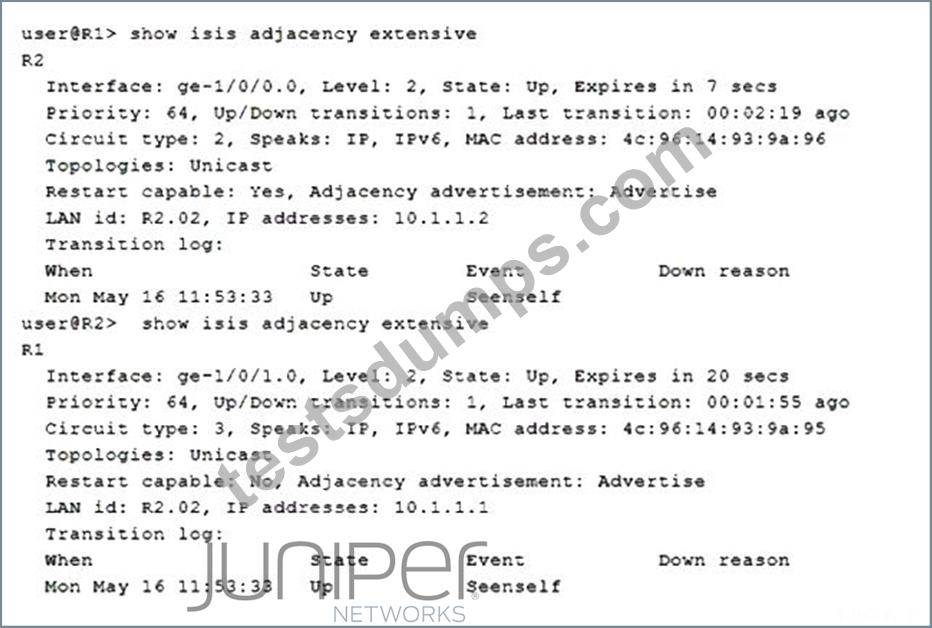
- A. R2 is configured to participate in both Level 1 and Level 2.
- B. R2 is configured to participate in Level 2 only.
- C. R1 is configured to participate in Level 2 only.
- D. R1 is configured to participate in both Level 1 and Level 2.
Answer: B,D
Explanation:
From the provided IS-IS adjacency outputs:
* R1 is configured to participate in both Level 1 and Level 2 (A): This is indicated by the adjacency states for both Level 1 and Level 2 on the R1 interfaces.
* R2 is configured to participate in Level 2 only (D): This is shown by the adjacency state for Level 2 only on the R2 interfaces.
References:
* The IS-IS adjacency outputs indicate the state and levels of participation for each router.
* Configuration and command references from "Example configs for VMRCAXP01W.txt" and other
* documents provide context for understanding IS-IS states and levels.
NEW QUESTION # 76
You have PIM SM multicast configure and running in a network environment comprised of EX4300 devices. Your customer report increased delay when switching channels using IPTV. To help decrease the delay, you implement PIM join balancing. You add the set protocol pim join- load-balance command to the configuration. After committing, you notice that the flows are still using one path.
In this scenario, which statement is correct?
- A. IGMP snooping must be configured.
- B. The interface must be specified to use for load balancing
- C. PIM join load-balancing also be configured.
- D. The clear pim join-distribution command must be issued.
Answer: D
NEW QUESTION # 77
You are troubleshooting an EVPN-VXLAN IP fabric and observe the loop shown in the exhibit.
Which two steps would you take to further troubleshoot this problem? (Choose two.)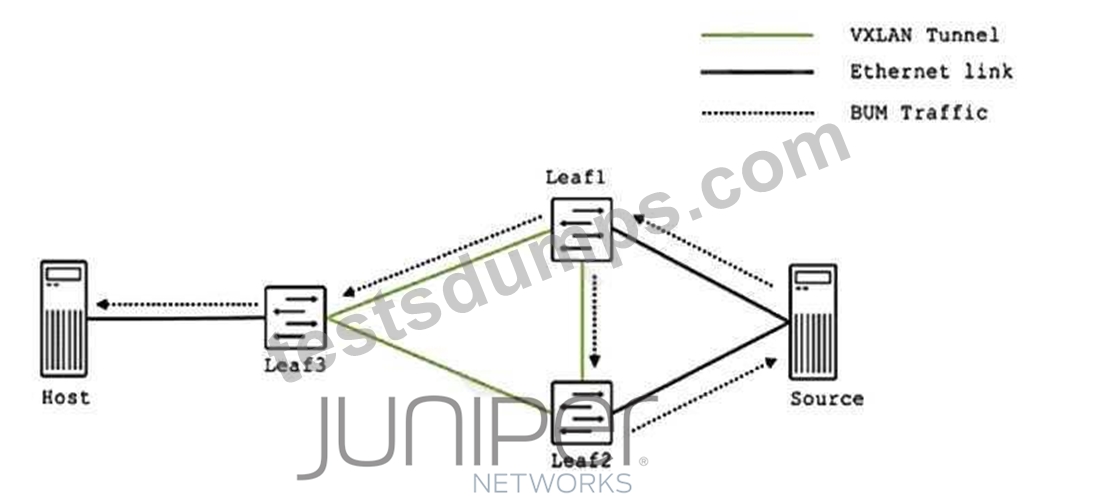
- A. Issue the show route table bgp.evpn.0 command on Leaf2 and verify that Type 4 routes are present.
- B. Verify that the same ESI is configured on the two links from the source.
- C. Verify that the same ESI is configured on the link from the host and that it matches the source.
- D. Issue the show route table bgp.evpn.0 command on Leaf2 and verify that Type 3 routes are present.
Answer: A,D
NEW QUESTION # 78
You are asked to troubleshoot voice quality issues on your newly implement VoIP network. You notice that the voice packets are being dropped. You have verified that the packets are correctly marked for expedited forwarding queue.
Referring to the exhibit, what must you configure to solve the problem?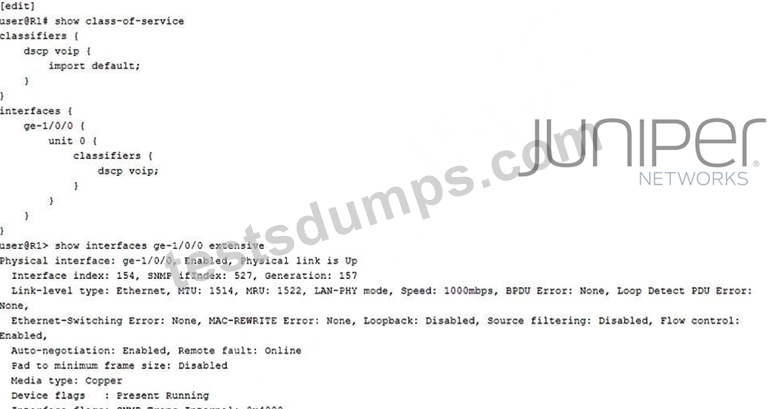
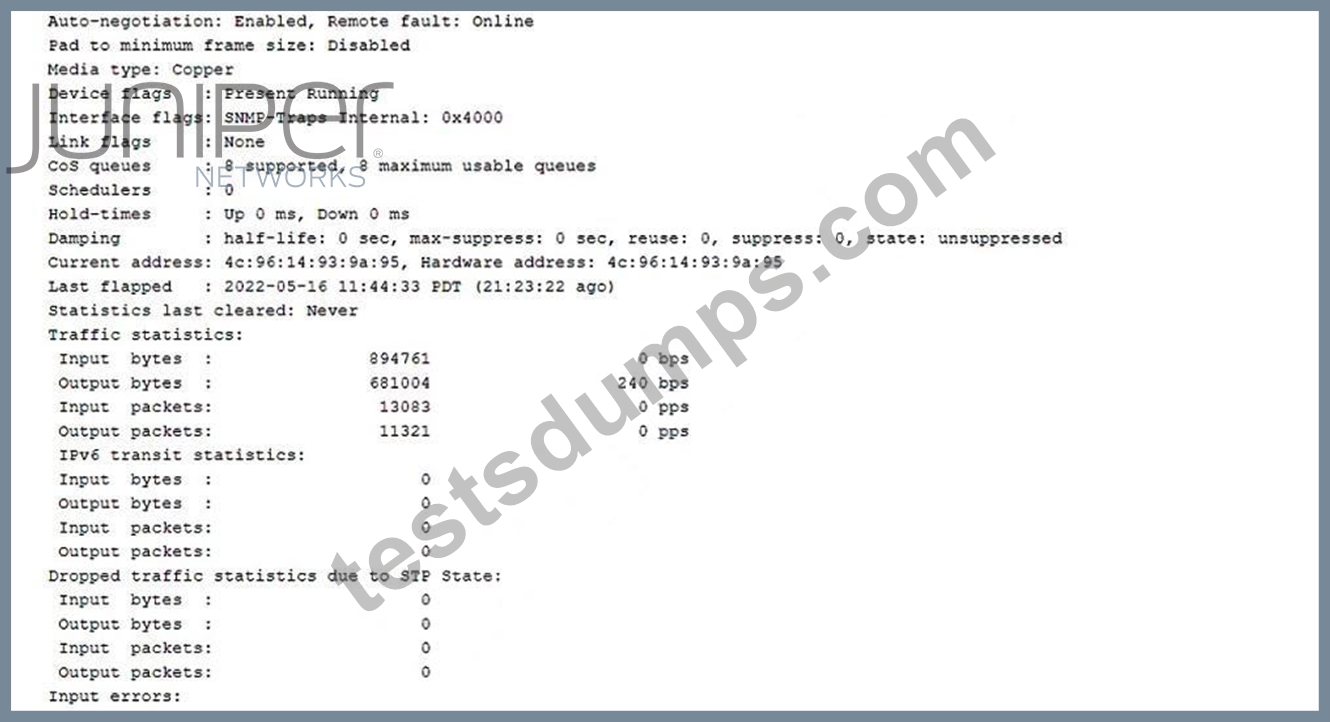
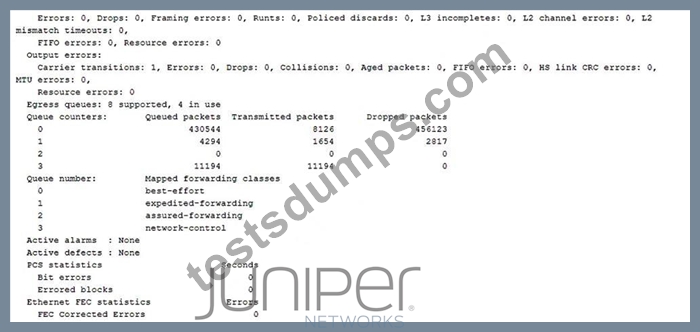
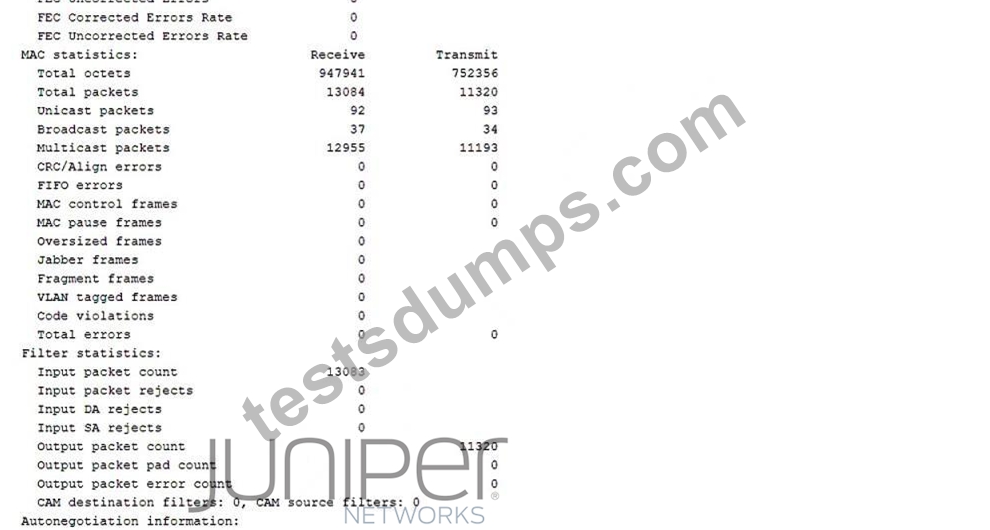
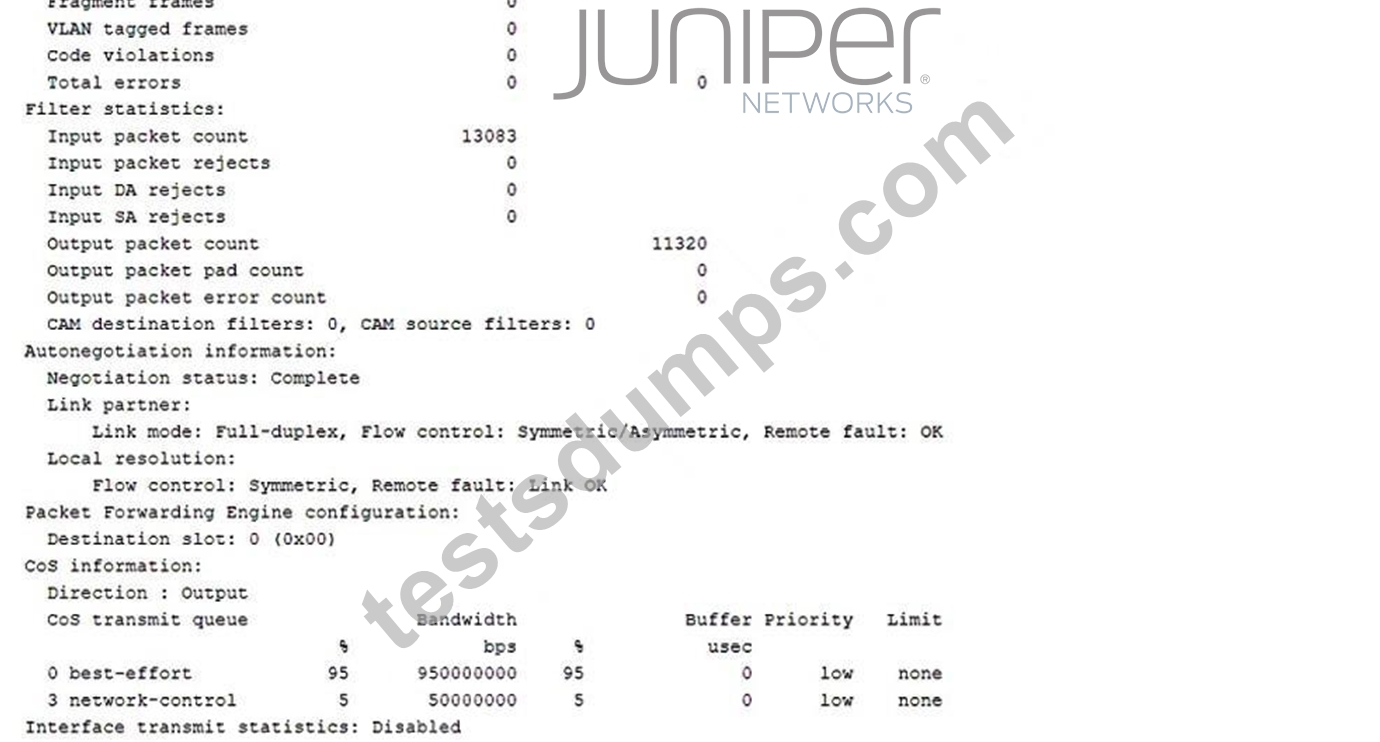
- A. You must configure a rewrite rule to ensure that the traffic is scheduled properly in the device.
- B. You must configure a multifield classifier to put the VoIP traffic in the correct queue.
- C. You must configure a scheduler to allocate bandwidth to the expedited forwarding queue.
- D. You must configure a policer to ensure that the queue is not being starved.
Answer: C
NEW QUESTION # 79
......
JN0-649 exam questions from TestsDumps dumps: https://actualanswers.testsdumps.com/JN0-649_real-exam-dumps.html (195 Q&As)
