

[Apr 25, 2024] New PCCSE Exam Dumps with High Passing Rate
Get PCCSE Braindumps & PCCSE Real Exam Questions
The PCCSE certification exam covers a range of topics related to cloud security, including cloud infrastructure security, network security, data security, and application security. PCCSE exam is designed to test the candidate's ability to identify and mitigate security risks and threats in cloud environments. It also tests the candidate's knowledge of compliance and regulatory requirements related to cloud security. Certified PCCSE professionals are recognized as experts in cloud security and are able to design and implement security solutions that meet the unique needs of cloud environments. Obtaining the PCCSE certification can help security professionals advance their careers and demonstrate their expertise in cloud security to potential employers.
Palo Alto Networks PCCSE: Prisma Certified Cloud Security Engineer is a highly sought-after certification for professionals who want to validate their skills in cloud security engineering. Prisma Certified Cloud Security Engineer certification is designed to test the knowledge and skills required to design, implement, and maintain secure cloud environments using Prisma Cloud. Prisma Cloud is a cloud security platform that provides full-stack security for multi-cloud and hybrid environments.
NEW QUESTION # 97
Which "kind" of Kubernetes object is configured to ensure that Defender is acting as the admission controller?
- A. MutatingWebhookConfiguration
- B. DestinationRules
- C. ValidatingWebhookConfiguration
- D. PodSecurityPolicies
Answer: C
Explanation:
In the context of Kubernetes, an admission controller is a piece of code that intercepts requests to the Kubernetes API server before the persistence of the object, but after the request is authenticated and authorized. The admission controller lets you apply complex validation and policy controls to objects before they are created or updated.
The ValidatingWebhookConfiguration is a Kubernetes object that tells the API server to send an admission validation request to a service (the admission webhook) when a request to create, update, or delete a Kubernetes object matches the rules defined in the configuration. The webhook can then approve or deny the request based on custom logic.
The MutatingWebhookConfiguration is similar but is used to modify objects before they are created or updated, which is not the primary function of an admission controller acting in a protective or validating capacity.
DestinationRules are related to Istio service mesh and are not relevant to Kubernetes admission control.
PodSecurityPolicies (PSPs) are a type of admission controller in Kubernetes but they are predefined by Kubernetes and do not require a specific configuration object like ValidatingWebhookConfiguration. PSPs are also deprecated in recent versions of Kubernetes.
Therefore, the correct answer is C. ValidatingWebhookConfiguration, as it is the Kubernetes object used to configure admission webhooks for validating requests, which aligns with the role of Defender acting as an admission controller in Prisma Cloud.
Reference from the provided documents:
The documents uploaded do not contain specific details about Kubernetes objects or Prisma Cloud's integration with Kubernetes. However, this explanation aligns with general Kubernetes practices and Prisma Cloud's capabilities in securing Kubernetes environments.
NEW QUESTION # 98
What is the frequency to create a compliance report? (Choose two.)
- A. One time
- B. Recurring
- C. Monthly
- D. Weekly
Answer: B,C
NEW QUESTION # 99
Which IAM Azure RQL query would correctly generate an output to view users who have sufficient permissions to create security groups within Azure AD and create applications?
- A. config from network where api.name = 'azure-active-directory-authorization-policy' AND json.rule = defaultUserRolePermissions.allowedToCreateSecurityGroups is false and defaultUserRolePermissions.allowedToCreateApps is true
- B. config from cloud.resource where api.name = 'azure-active-directory-authorization-policy' AND json.rule = defaultUserRolePermissions.allowedToCreateSecurityGroups is true and defaultUserRolePermissions.allowedToCreateApps is true
- C. config where api.name = 'azure-active-directory-authorization-policy' AND json.rule = defaultUserRolePermissions.allowedToCreateSecurityGroups is true and defaultUserRolePermissions.allowedToCreateApps is true
- D. config from cloud.resource where api.name = 'azure-active-directory-authorization-policy' AND json.rule = defaultUserRolePermissions exists
Answer: B
NEW QUESTION # 100
Which option shows the steps to install the Console in a Kubernetes Cluster?
- A. Download the Console and Defender image Download YAML for Defender from the document site Deploy Defender YAML using kubectl
- B. Download the Console and Defender image Generate YAML for Defender
Deploy Defender YAML using kubectl - C. Download and extract release tarball Download the YAML for Console Deploy Console YAML using kubectl
- D. Download and extract release tarball Generate YAML for Console
Deploy Console YAML using kubectl
Answer: D
Explanation:
The installation of the Prisma Cloud Console in a Kubernetes cluster involves a series of steps that start with preparing the necessary deployment configurations, typically provided as YAML files. The process begins by downloading and extracting the release tarball, which contains the necessary files and instructions for the deployment. After extracting the tarball, you generate YAML files for the Console deployment. These YAML files define the Kubernetes resources needed to deploy and run the Console, such as Deployments, Services, and ConfigMaps. Finally, you deploy the Console by applying the generated YAML files using the kubectl command, which communicates with the Kubernetes API to create the specified resources in your cluster.
This process is aligned with Kubernetes best practices for deploying applications and is indicative of the steps required for deploying complex applications like the Prisma Cloud Console. The method ensures that all necessary configurations and dependencies are correctly defined and deployed in the Kubernetes environment.
NEW QUESTION # 101
Which intensity setting for anomaly alerts is used for the measurement of 100 events over 30 days?
- A. Low
- B. Very High
- C. High
- D. Medium
Answer: D
Explanation:
In the context of setting anomaly alert intensities in Prisma Cloud, an intensity setting of "Medium" could be used for the measurement of 100 events over 30 days. This setting indicates a moderate level of anomaly detection sensitivity, which is suitable for environments where there is a need to balance between detecting potential security issues and minimizing false positives.
NEW QUESTION # 102
An administrator wants to install the Defenders to a Kubernetes cluster. This cluster is running the console on the default service endpoint and will be exporting to YAML.
Console Address: $CONSOLE_ADDRESS Websocket Address: $WEBSOCKET_ADDRESS User: $ADMIN_USER Which command generates the YAML file for Defender install?
- A. <PLATFORM>/twistcli defender export kubernetes \
--address $WEBSOCKET_ADDRESS \
--user $ADMIN_USER \
--cluster-address $CONSOLE_ADDRESS - B. <PLATFORM>/twistcli defender \
--address $CONSOLE_ADDRESS \
--user $ADMIN_USER \
--cluster-address $CONSOLE_ADDRESS - C. <PLATFORM>/twistcli defender YAML kubernetes \
--address $CONSOLE_ADDRESS \
--user $ADMIN_USER \
--cluster-address $WEBSOCKET_ADDRESS - D. <PLATFORM>/twistcli defender export kubernetes \
--address $CONSOLE_ADDRESS \
--user $ADMIN_USER \
--cluster-address $WEBSOCKET_ADDRESS
Answer: D
Explanation:
The correct command to generate the YAML file for Defender install in a Kubernetes cluster, considering the console and websocket addresses, as well as the admin user, would typically involve specifying the addresses and user details. The option D seems most aligned with standard practices for such commands, where you export the Defender configuration for Kubernetes, specifying the console and websocket addresses along with the user details.
NEW QUESTION # 103
What are two key requirements for integrating Okta with Prisma Cloud when multiple Amazon Web Services (AWS) cloud accounts are being used? (Choose two.)
- A. Super Administrator permissions
- B. An Okta API token for the primary AWS account
- C. Multiple instances of the Okta app
- D. A valid subscription for the IAM security module
Answer: A,B
NEW QUESTION # 104
An administrator wants to install the Defenders to a Kubernetes cluster. This cluster is running the console on the default service endpoint and will be exporting to YAML.
Console Address: $CONSOLE_ADDRESS Websocket Address: $WEBSOCKET_ADDRESS User:
$ADMIN_USER
Which command generates the YAML file for Defender install?
- A. <PLATFORM>/twistcli defender export kubernetes \
--address $WEBSOCKET_ADDRESS \
--user $ADMIN_USER \
--cluster-address $CONSOLE_ADDRESS - B. <PLATFORM>/twistcli defender \
--address $CONSOLE_ADDRESS \
--user $ADMIN_USER \
--cluster-address $CONSOLE_ADDRESS - C. <PLATFORM>/twistcli defender YAML kubernetes \
--address $CONSOLE_ADDRESS \
--user $ADMIN_USER \
--cluster-address $WEBSOCKET_ADDRESS - D. <PLATFORM>/twistcli defender export kubernetes \
--address $CONSOLE_ADDRESS \
--user $ADMIN_USER \
--cluster-address $WEBSOCKET_ADDRESS
Answer: D
NEW QUESTION # 105
A customer is interested in PCI requirements and needs to ensure that no privilege containers can start in the environment.
Which action needs to be set for "do not use privileged containers"?
- A. Fail
- B. Block
- C. Prevent
- D. Alert
Answer: B
Explanation:
Block-Defender stops the entire container if a process that violates your policy attempts to run.
https://docs.prismacloudcompute.com/docs/enterprise_edition/runtime_defense/runtime_defense_containers.html#_effect
NEW QUESTION # 106
Which two integrated development environment (IDE) plugins are supported by Prisma Cloud as part of its Code Security? (Choose two.)
- A. Visual Studio Code
- B. CircleCI
- C. BitBucket
- D. IntelliJ
Answer: A,D
Explanation:
Prisma Cloud by Palo Alto Networks extends its cloud security capabilities to the development environment through the integration with Integrated Development Environments (IDEs) plugins. Among the available options, Visual Studio Code and IntelliJ are supported by Prisma Cloud as part of its Code Security features. These IDE plugins enable developers to incorporate security insights directly into their development workflows, facilitating early detection and remediation of vulnerabilities and compliance issues in the codebase. Visual Studio Code, known for its versatility and extensive plugin ecosystem, and IntelliJ, popular for its powerful coding assistance and ergonomic design, are both widely used by developers. The integration with Prisma Cloud allows for seamless scanning of code for vulnerabilities, misconfigurations, and compliance with security policies, fostering a DevSecOps culture by shifting security left into the early stages of the development lifecycle.
NEW QUESTION # 107
Which option shows the steps to install the Console in a Kubernetes Cluster?
- A. Download and extract release tarball Download the YAML for Console Deploy Console YAML using kubectl
- B. Download the Console and Defender image Download YAML for Defender from the document site Deploy Defender YAML using kubectl
- C. Download the Console and Defender image Generate YAML for Defender Deploy Defender YAML using kubectl
- D. Download and extract release tarball Generate YAML for Console Deploy Console YAML using kubectl
Answer: A
NEW QUESTION # 108
What is an example of an outbound notification within Prisma Cloud?
- A. PagerDuty
- B. Tenable
- C. Qualys
- D. AWS Inspector
Answer: A
NEW QUESTION # 109
Move the steps to the correct order to set up and execute a serverless scan using AWS DevOps.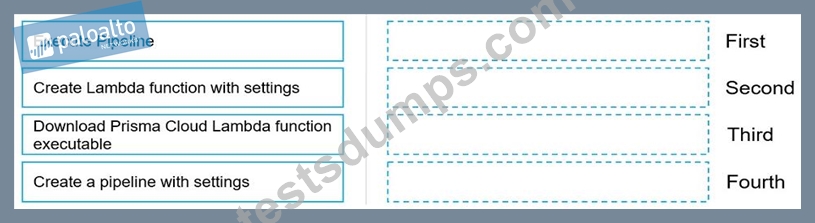
Answer:
Explanation: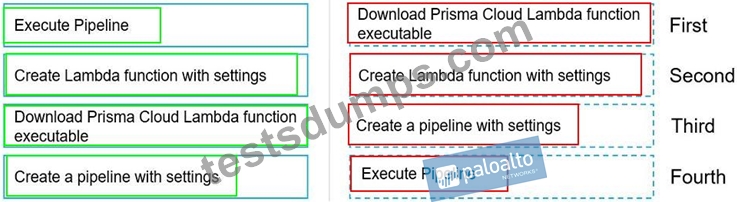
NEW QUESTION # 110
An administrator has been tasked with creating a custom service that will download any existing compliance report from a Prisma Cloud Enterprise.
tenant-In which order will the APIs be executed for this service? (Drag the steps into the correct order of occurrence from the first step to the last)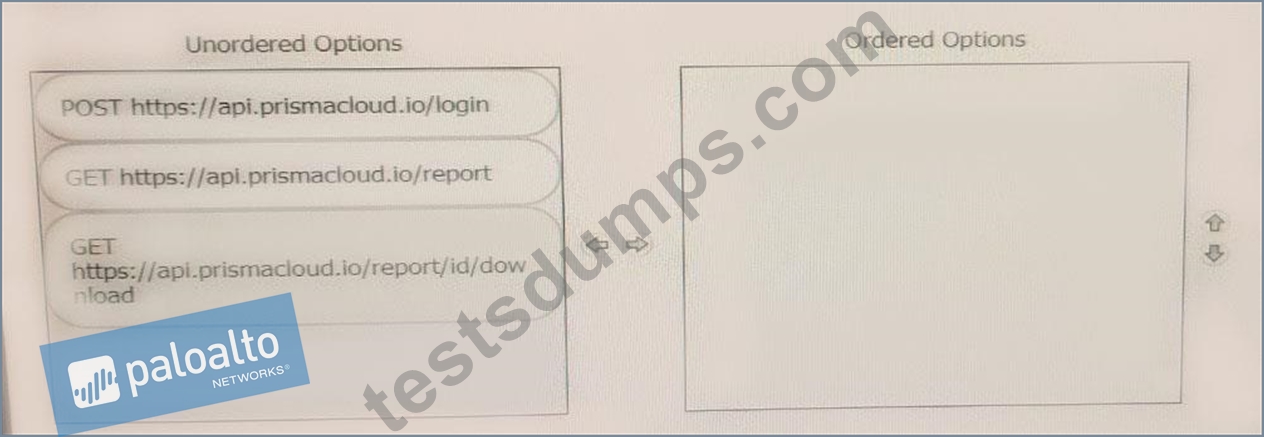
Answer:
Explanation: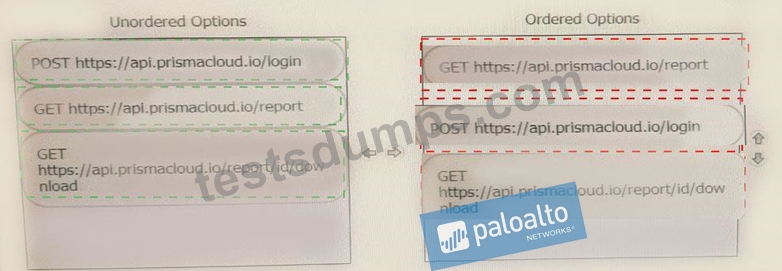
NEW QUESTION # 111
An S3 bucket within AWS has generated an alert by violating the Prisma Cloud Default policy "AWS S3 buckets are accessible to public". The policy definition follows:
config where cloud.type = 'aws' AND api.name='aws-s3api-get-bucket-acl' AND json.rule="((((acl.grants[? (@.grantee=='AllUsers')] size > 0) or policyStatus.isPublic is true) and publicAccessBlockConfiguration does not exist) or ((acl.grants[?(@.grantee=='AllUsers')] size > 0) and publicAccessBlockConfiguration.ignorePublicAcis is false) or (policyStatus.isPublic is true and publicAccessBlockConfiguration.restrictPublicBuckets is false)) and websiteConfiguration does not exist" Why did this alert get generated?
- A. network traffic to the S3 bucket
- B. configuration of the S3 bucket
- C. an event within the cloud account
- D. anomalous behaviors
Answer: A
NEW QUESTION # 112
What is the order of steps to create a custom network policy?
(Drag the steps into the correct order of occurrence, from the first step to the last.)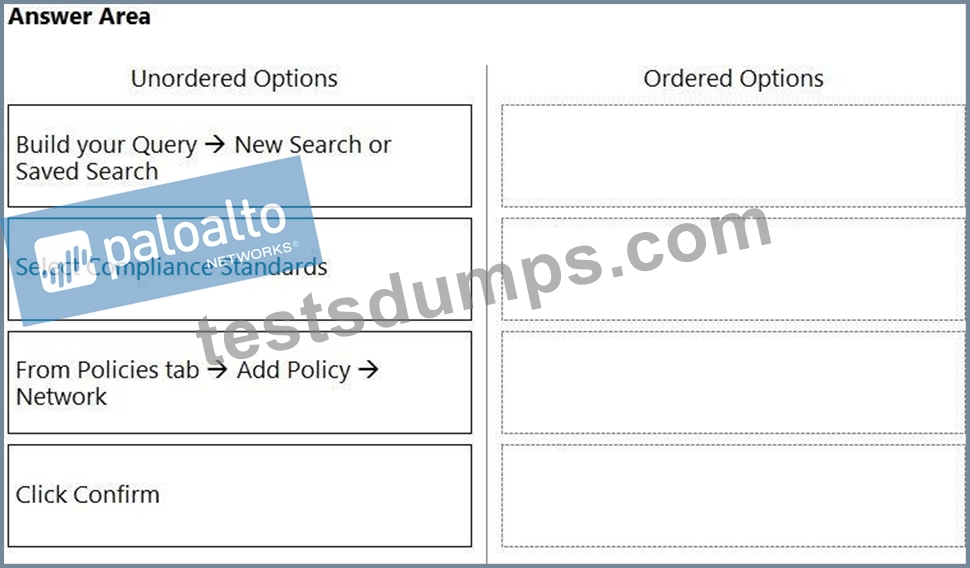
Answer:
Explanation: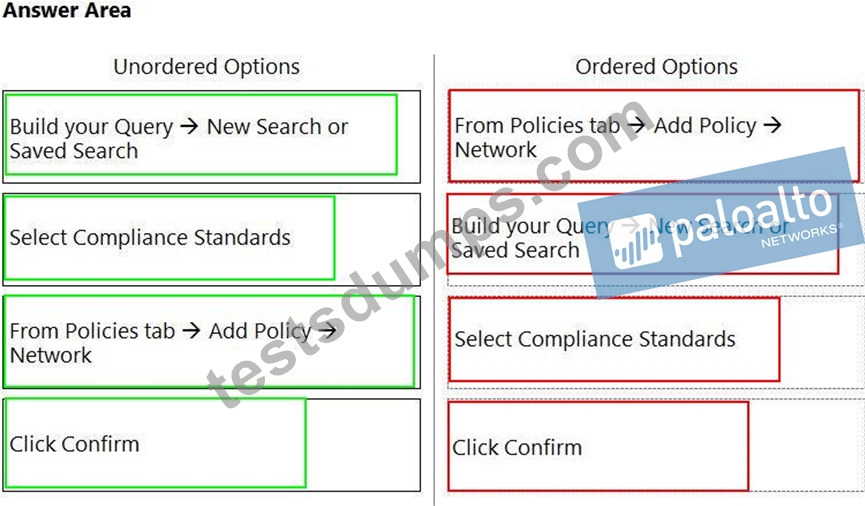
Reference:
https://docs.paloaltonetworks.com/prisma/prisma-cloud/prisma-cloud-admin/prisma-cloud-policies/create-a- policy.html Select Policies and click Add Policy Build the query Add the compliance standards Click Submit.
https://docs.paloaltonetworks.com/prisma/prisma-cloud/prisma-cloud-admin/prisma-cloud-policies/create-a-policy
NEW QUESTION # 113
......
PCCSE Dumps To Pass Palo Alto Networks Exam in 24 Hours - TestsDumps: https://actualanswers.testsdumps.com/PCCSE_real-exam-dumps.html
