

[Jul-2025] P_SAPEA_2023 exam torrent SAP study guide
Use Valid New P_SAPEA_2023 Test Notes & P_SAPEA_2023 Valid Exam Guide
SAP P_SAPEA_2023 Exam Syllabus Topics:
| Topic | Details |
|---|---|
| Topic 1 |
|
| Topic 2 |
|
| Topic 3 |
|
| Topic 4 |
|
NEW QUESTION # 12
As part of the mapping of a Business Architecture to the Solution Architecture, an Environment & Location Diagram must be developed in the Technology Architecture phase. In this context, numerous architecture decisions have to be made. Among other things, you must check which SAP BTP services and which SAP SaaS solutions are available as part of the Solution Architecture in which data center of the desired hyperscaler. How do you go about this validation?
- A. I use the SAP Business Accelerator Hub (api.sap.com) because it provides all the required information regarding SAP BTP service and SAP SaaS solution availability for each hyperscaler, in a central location.
- B. I use the SAP Discovery Center to check in which data centers the respective SAP BTP services and the SAP SaaS solutions are available.
- C. I use the SAP Discovery Center to check which of the selected SAP BTP services are offered by which hyperscaler. With help from the SAP Trust Center, I check in which data center the involved SAP SaaS solutions are available.
Answer: C
Explanation:
Explanation
According to the SAP Discovery Center 1 and the SAP Trust Center 2, the steps involved in this validation are:
Use the SAP Discovery Center to check which of the selected SAP BTP services are offered by which hyperscaler. The SAP Discovery Center is a platform that provides access to SAP BTP services, events, and related resources, and helps you to implement your use cases on SAP BTP with step-by-step guidance and support from topic experts and SAP Community. In the Service Catalog section of the SAP Discovery Center, you can browse and filter the available SAP BTP services by category, region, or hyperscaler. You can also compare the features and pricing of different services, and learn how to use them in your projects.
Use the SAP Trust Center to check in which data center the involved SAP SaaS solutions are available.
The SAP Trust Center is a platform that provides information on cloud performance, security, privacy, and compliance. In the Certification and Compliance section of the SAP Trust Center, you can find certificates, reports, and attestations that show how SAP meets various industry standards and regulatory requirements. You can also filter the documents by solution, region, or hyperscaler, and download them for your reference.
The other options (A and C) are not correct for how to validate the availability of SAP BTP services and SAP SaaS solutions in the desired hyperscaler's data center, because they either do not exist or do not provide the required information. For example:
Option A is not correct because there is no such platform as SAP Business Accelerator Hub (api.sap.com) that provides all the required information regarding SAP BTP service and SAP SaaS solution availability for each hyperscaler. The correct name of the platform is SAP API Business Hub (api.sap.com), which is a platform that provides access to SAP APIs, events, and related resources, but it does not provide any information on the availability of SAP BTP services or SAP SaaS solutions for each hyperscaler or data center.
Option C is not correct because the SAP Discovery Center does not provide any information on the availability of SAP SaaS solutions for each hyperscaler or data center. The SAP Discovery Center only provides information on the availability of SAP BTP services for each hyperscaler or region, but not for specific data centers. To check the availability of SAP SaaS solutions for each data center, you need to use the SAP Trust Center instead.
NEW QUESTION # 13
As the Chief Enterprise Architect of Wanderlust GmbH, you are aware that EA principles should correlate to the Business and IT Strategic Objectives and decisions. In the list given below, the left column has some Wanderlust Business/IT objectives and decisions and the right column has some EA principles. Which objectives and decisions correlate best to which principle?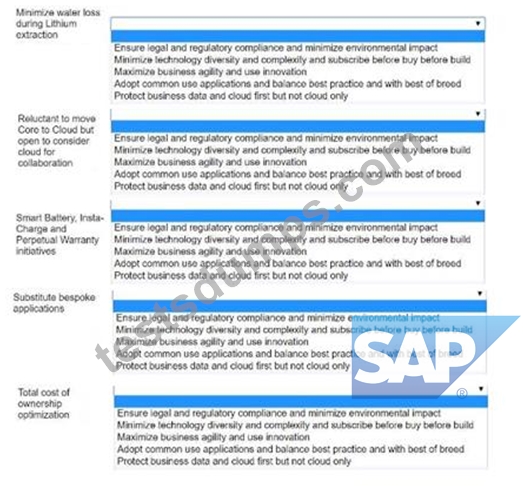
Answer:
Explanation: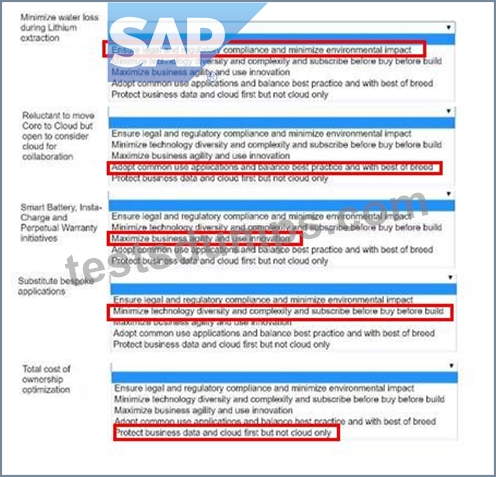
NEW QUESTION # 14
What kind of applications can you develop with SAP Business Application Studio?
- A. SAPUI5 (SAP Fiori) applications
- B. ABAP applications
- C. SAPUI5 (SAP Fiori) applications and ABAP applications
Answer: A
Explanation:
SAP Business Application Studio is a modern development environment designed to support the development of various SAP-centric applications. Among the supported application types are:
SAPUI5 (SAP Fiori) applications (C): SAP Business Application Studio provides extensive tools and templates specifically tailored for developing SAPUI5 applications, which are the backbone of the SAP Fiori user experience. This includes support for frontend development with rich user interfaces, integration with SAP services, and adherence to SAP Fiori design principles.
Options A and B are incorrect because SAP Business Application Studio does not support ABAP development directly within its environment. ABAP development traditionally requires a different set of tools and environments provided by SAP, such as the ABAP Development Tools (ADT) in Eclipse or the ABAP environment on SAP Cloud Platform.
Reference:
SAP Business Application Studio documentation.
SAP Fiori development guidelines provided by SAP.
NEW QUESTION # 15
For the next Architecture Board meeting, you need to determine the next steps required after the business, application/data and technology architecture designs have been created. What do you recommend?
- A. Finalizing the Business, Application/Data, and Technology Architecture artifacts. Building an Architecture Roadmap. Creating a first draft of the Project/Rollout Project plan.
- B. Reviewing Business Application/Data and Technology Architecture artifacts with stakeholders and signing off on first versions.Using Transition Architectures to build the Architecture Roadmap. Creating first drafts of the required work packages and the Project/Rollout plan.
- C. Establishing change management processes for the management of the business application/data and technology artifacts Handing over the artifacts to the implementation partner and rolling out the project
Answer: B
Explanation:
Explanation
According to the SAP Enterprise Architect framework, which is based on the TOGAF ADM, the next steps are:
Reviewing Business, Application/Data, and Technology Architecture artifacts with stakeholders and signing off on first versions. This step involves validating and verifying the architecture designs with the relevant stakeholders, such as business owners, users, developers, and vendors. The goal is to ensure that the architecture designs meet the requirements and expectations of the project, and to obtain formal approval for the first versions of the artifacts.
Using Transition Architectures to build the Architecture Roadmap. This step involves defining and prioritizing the Transition Architectures, which are intermediate states between the Baseline Architecture (the current situation) and the Target Architecture (the desired future state). The Transition Architectures describe how to move from one state to another in a feasible and manageable way, taking into account the constraints and dependencies of the project. The Architecture Roadmap is a document that outlines the sequence and timing of the Transition Architectures, as well as the deliverables, resources, and risks associated with each one.
Creating first drafts of the required work packages and the Project/Rollout plan. This step involves identifying and defining the work packages, which are units of work that can be assigned to a project team or a vendor for implementation. The work packages specify the scope, objectives, dependencies, assumptions, and acceptance criteria of each unit of work. The Project/Rollout plan is a document that describes how to execute and monitor the work packages, as well as how to manage the change management, quality assurance, and governance aspects of the project.
The other options (B and C) are not correct for the next steps required after the architecture designs have been created, because they either skip or misrepresent some of the steps in the SAP Enterprise Architect framework.
For example:
Option B is not correct because it does not include reviewing and signing off on the first versions of the architecture artifacts with stakeholders, which is an important step to ensure alignment and agreement on the architecture designs. It also does not mention using Transition Architectures to build the Architecture Roadmap, which is a key step to define and prioritize the intermediate states between the Baseline and Target Architectures.
Option C is not correct because it does not follow the SAP Enterprise Architect framework at all. It suggests establishing change management processes for the management of the architecture artifacts, which is something that should be done earlier in the framework, not after creating the architecture designs. It also suggests handing over the artifacts to the implementation partner and rolling out the project, which is a premature and risky move that does not take into account the need for defining Transition Architectures, work packages, and Project/Rollout plan.
For more information on the SAP Enterprise Architect framework and its phases, you can refer to SAP Enterprise Architect | SAP Learning or SAP Certified Professional - SAP Enterprise Architect.
NEW QUESTION # 16
Why would you recommend building SAP Side-by-Side Extensions to an S/4HANA system based on SAP BTP?
- A. Extensions should be built on SAP BTP because SAP BTP is the only option for building a consistent user experience based on SAP Fiori UX styles.
- B. Extensions on SAP BTP can maintain SAP user and security context and allow the use of S/4HANA eventing.
- C. Extensions on SAP BTP technology can easily use of S/4HANA eventing.
Answer: B
Explanation:
There are a few reasons why you would recommend building SAP Side-by-Side Extensions to an S/4HANA system based on SAP BTP.
SAP BTP is a cloud-based platform, which means that extensions can be developed, deployed, and managed in the cloud. This makes it easy to scale and manage extensions, and it also makes it easier to collaborate with other developers.
SAP BTP provides a number of services that can be used to build extensions, such as SAP Cloud Platform Integration and SAP Cloud Platform Event Mesh. These services can help to make extensions more scalable, reliable, and secure.
SAP BTP supports a variety of programming languages, which means that developers can use the language they are most comfortable with. This can help to make the development process more efficient and productive.
In addition to these reasons, SAP BTP also allows extensions to maintain SAP user and security context and allow the use of S/4HANA eventing. This is important because it ensures that users are only able to access the data and functionality that they are authorized to access, and it also allows extensions to react to events that occur in S/4HANA.
Therefore, SAP BTP is a good choice for building SAP Side-by-Side Extensions to an S/4HANA system.
Extensions on SAP BTP can maintain SAP user and security context, which means that the extensions can use the same authentication and authorization mechanisms as the S/4HANA system and respect the user roles and permissions defined in the S/4HANA system.
Extensions on SAP BTP can use S/4HANA eventing, which means that the extensions can subscribe to business events that are triggered by the S/4HANA system and react to them accordingly. For example, an extension can listen to a sales order creation event and perform some additional logic or integration based on the event data.
Extensions on SAP BTP can leverage the SAP Cloud Platform Integration Suite and the SAP HANA Data Management Suite, which provide a comprehensive set of services and tools for different integration scenarios, such as process integration, data integration, analytics integration, user integration, and thing integration.
Extensions on SAP BTP can benefit from the cloud-native capabilities of SAP BTP, such as scalability, elasticity, availability, and security. Extensions on SAP BTP can also take advantage of the various programming languages, frameworks, and technologies supported by SAP BTP, such as Java, Node.js, Python, Go, PHP, CAP, or serverless functions.
Verified : 6: https://help.sap.com/viewer/9d1db9835307451daa8c930fbd9ab264/2020.002/en-US/6f7b0c5a5e0d4f8a8b7c0e9c6b6a7f5e.html#loio6f7b0c5a5e0d4f8a8b7c0e9c6b6a7f5e__section_2
NEW QUESTION # 17
As Chief Enterprise Architect of Wanderlust GmbH, you have just finished documenting the business ecosystem around online marketing. The CEO is asking for a suitable artifact to rejuvenate online marketing with a set of employees and partners. What would you do to be ready with the right information in this situation?
- A. Extend the organization map into a statement of architecture work.
- B. Extend the organizational map by detailing the organization units, partners and stakeholder groups further into business roles and personas.
- C. Create a stakeholder map.
- D. Extend the business ecosystem into business capabilities and processes.
Answer: C
Explanation:
In order to rejuvenate the online marketing efforts with a set of employees and partners, creating a stakeholder map is the appropriate next step. A stakeholder map will help to identify and categorize all the relevant parties involved in the online marketing ecosystem, including internal and external stakeholders, their interests, influence, and the relationships between them. This artifact provides a visual representation of all stakeholders, their expectations, and requirements, which is critical for developing a targeted strategy for rejuvenation.
= Stakeholder mapping is a common practice in enterprise architecture to ensure that all parties affected by a project are identified and their needs are considered in the decision-making process.
NEW QUESTION # 18
Which of the following lists of SAP Enterprise Architecture artifacts support making informed Target Application Architecture decisions that are aligned with the strategic direction of a company?
- A. Solution Context/Solution Concept/Stakeholder Map/Baseline Business and Solution Architecture
- B. Stakeholder Map/Business Strategy Map/Solution Strategy/Architecture Roadmap
- C. Principles Standards, Guidelines/Solution Context/Baseline Business and Solution Architecture
Answer: A
Explanation:
Explanation
The answer is C. Solution Context/Solution Concept/Stakeholder Map/Baseline Business and Solution Architecture.
The following are the SAP Enterprise Architecture artifacts that support making informed Target Application Architecture decisions that are aligned with the strategic direction of a company:
Solution Context - This artifact provides an overview of the current business and IT landscape, including the business goals, objectives, and drivers.
Solution Concept - This artifact describes the proposed Target Application Architecture, including the high-level business capabilities, processes, and data.
Stakeholder Map - This artifact identifies the key stakeholders involved in the Target Application Architecture project, and their interests and concerns.
Baseline Business and Solution Architecture - This artifact provides a snapshot of the current Business and Solution Architecture, which can be used to compare to the Target Application Architecture and identify areas for improvement.
These artifacts can be used to make informed decisions about the Target Application Architecture by providing a clear understanding of the current landscape, the desired future state, and the needs of the key stakeholders.
NEW QUESTION # 19
In the SAP Enterprise Architecture Framework, which of the following artifacts are part of the opportunities & solution phase? Note: There are 3 correct answers to this question.
- A. Implementation Roadmap
- B. Business Architecture Roadmap
- C. Migration plan
- D. Work Breakdown structure
- E. Application Architecture Roadmap
Answer: A,B,C
Explanation:
In the SAP Enterprise Architecture Framework, the opportunities & solution phase includes developing artifacts that help in visualizing the progression from current operations to the future state. The Business Architecture Roadmap outlines how business strategies will evolve, linking business goals with architectural changes. The Implementation Roadmap provides a detailed plan for the deployment of SAP solutions, including time frames and stages of implementation. The Migration Plan offers a comprehensive strategy for moving from legacy systems to modern SAP solutions, detailing the necessary steps for data migration and system transition.
Reference = These artifacts are described within the framework and guidelines for enterprise architecture development provided by SAP, focusing on ensuring that the solutions proposed are feasible, properly planned, and aligned with the business strategies and objectives.
NEW QUESTION # 20
Green Elk & Company is the world's leading manufacturer of agricultural and forestry machinery. The former company slogan "Elk always runs" has recently been changed to "Elk feeds the world". One of Green Elk's strategic goals is to increase its revenue in the emerging markets of China, India, and other parts of Asia by 80 % within three years. This requires a new business model that caters to significantly smaller farms with limited budgets. You are the Chief Enterprise Architect and the CIO asks you to assess the now business model for smaller farms with smaller budgets. By applying the Sustainable Business Model Canvas, which sequence of steps is best practice?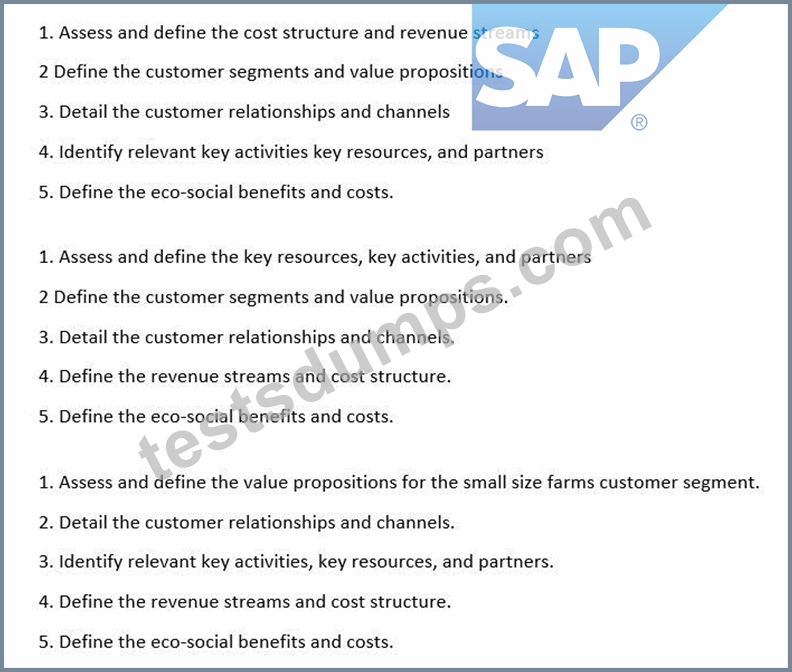
- A. 1. Assess and define the cost structure and revenue streams/2 Define the customer segments and value propositions/3. Detail the customer relationships and channels/4. Identify relevant key activities key resources, and partners/5. Define the eco-social benefits and costs.
- B. 1. Assess and define the value propositions for the small size farms customer segment. /2. Detail the customer relationships and channels. /3. Identify relevant key activities, key resources, and partners. /4. Define the revenue streams and cost structure. /5. Define the eco-social benefits and costs.
- C. 1. Assess and define the key resources, key activities, and partners/2 Define the customer segments and value propositions. /3. Detail the customer relationships and channels. /4. Define the revenue streams and cost structure. /5. Define the eco-social benefits and costs.
Answer: B
Explanation:
The Sustainable Business Model Canvas approach for assessing new business models, especially for smaller farms with smaller budgets, starts with understanding the unique value propositions tailored to the needs of small-size farm owners. This is crucial in creating offerings that resonate well with the target market's requirements and constraints. Following this, detailing customer relationships and channels becomes essential in establishing and maintaining a strong connection with the market segment, ensuring the delivery mechanism aligns with their preferences and capabilities. The next step involves identifying the key activities, resources, and partnerships necessary to deliver on the value proposition effectively, which is critical for operational execution and sustainability. Subsequently, defining the revenue streams and cost structure is paramount to ensure financial viability and strategic pricing that aligns with the target market's budgetary limitations. Lastly, delineating the eco-social benefits and costs integrates the broader impact of the business model, aligning with sustainable and ethical business practices, which is increasingly important for modern enterprises.
Reference = This sequence is aligned with the methodologies proposed by Alexander Osterwalder in the context of business model development and specifically tailored by SAP for digital business modeling and value engineering within the SAP ecosystem. This approach encompasses strategies for optimizing business processes through value discovery workshops and the application of value management processes across various lifecycle phases (Source: SAP Enterprise Support Services documentation, Digital Business Modelling guidelines, and SAP Value Engineering methodologies).
NEW QUESTION # 21
As the Chief Enterprise Architect of Wanderlust GmbH, you are aware that EA principles should correlate to the Business and IT Strategic Objectives and decisions. In the list given below, the left column has some Wanderlust Business/IT objectives and decisions and the right column has some EA principles. Which objectives and decisions correlate best to which principle?
Answer:
Explanation: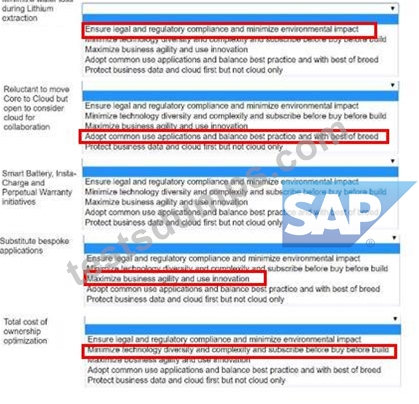
NEW QUESTION # 22
As Chief Enterprise Architect of Wanderlust GmbH, you have just finished documenting the business ecosystem around online marketing. The CEO is asking for a suitable artifact to rejuvenate online marketing with a set of employees and partners. What would you do to be ready with the right information in this situation?
- A. Extend the organization map into a statement of architecture work.
- B. Extend the organizational map by detailing the organization units, partners and stakeholder groups further into business roles and personas.
- C. Extend the business ecosystem into business capabilities and processes.
- D. Create a stakeholder map.
Answer: B
Explanation:
Explanation
A stakeholder map is a visual representation of the people and organizations that have an interest in the online marketing ecosystem. It is useful for understanding the different perspectives of the stakeholders and identifying the key stakeholders that need to be involved in the rejuvenation of the ecosystem.
A statement of architecture work is a document that describes the scope, objectives, and deliverables of an architecture project. It is not as detailed as a stakeholder map and it does not provide a visual representation of the stakeholders.
Extending the business ecosystem into business capabilities and processes is a good way to understand the current state of the ecosystem and identify the areas where improvement is needed. However, it does not provide a detailed view of the stakeholders involved in the ecosystem.
Therefore, the best course of action is to extend the organizational map by detailing the organization units, partners and stakeholder groups further into business roles and personas. This will provide a more detailed view of the stakeholders involved in the ecosystem and it will help to understand the different perspectives of the stakeholders.
Here are some of the benefits of extending the organizational map into business roles and personas:
It can help to identify the key stakeholders that need to be involved in the rejuvenation of the ecosystem.
It can help to understand the different perspectives of the stakeholders and identify any potential conflicts of interest.
It can help to ensure that the rejuvenation of the ecosystem is aligned with the needs of the stakeholders.
NEW QUESTION # 23
A custom web application developed with SAPUI5 and running on SAP Business Technology Platform uses large custom data objects deployed in a central data store (SAP HANA Cloud). The solution architect of the application is unsure about which tools to use for integration of this data from different SAP Sources into the central data store and asks you as the Enterprise Architect for guidance. Under which conditions is a data-oriented integration approach (Data Integration) preferable to other integration styles?
- A. If the data objects are built with data from different SAP and non-SAP sources that can be structured and unstructured, change with high frequency, and need to be cleansed, correlated and partly newly calculated.
- B. If the data objects are built with data from different SAP and non-SAP sources that can be structured and unstructured, change with high frequency, and need to be newly calculated.
- C. The data objects are built with data from different SAP and non-SAP sources that change infrequently and are available from REST and Message APIs (event-driven systems).
Answer: A
Explanation:
Explanation
Data-oriented integration is a method of integrating data from different sources into a single data store. This approach is often used when the data is heterogeneous, meaning that it comes from different sources and in different formats. Data-oriented integration can also be used when the data is frequently updated, as it allows for the data to be updated in real time.
The following are some of the benefits of using data-oriented integration:
It can help to improve the performance of applications that access the data.
It can help to reduce the complexity of the integration process.
It can help to improve the quality of the data.
However, data-oriented integration can also be more complex to implement than other integration styles.
The conditions under which data-oriented integration is preferable to other integration styles are:
When the data is heterogeneous and comes from different sources.
When the data is frequently updated.
When the data needs to be cleansed, correlated, and partly newly calculated.
In the case of the custom web application, the data objects are built with data from different SAP and non-SAP sources that can be structured and unstructured, change with high frequency, and need to be cleansed, correlated, and partly newly calculated. Therefore, a data-oriented integration approach is preferable to other integration styles.
NEW QUESTION # 24
You, as the Chief Enterprise Architect of Wanderlust GmbH, have been trying to formulate the Business Strategy Map. You are currently working on the strategic objective to "Increase supply reliability of Lithium batteries". Arrange the elements of the Business Strategy Map into the right order that shows the dependencies between these elements.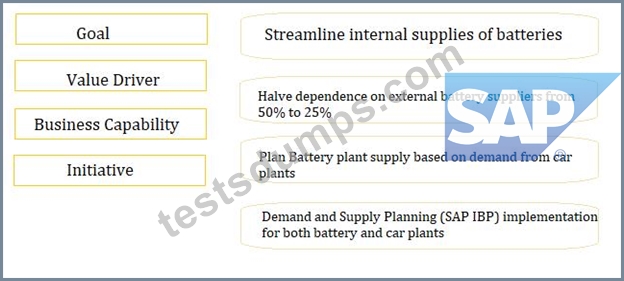
Answer:
Explanation: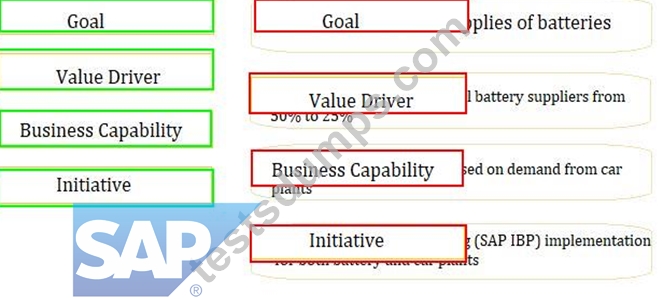
NEW QUESTION # 25
Select the most appropriate sequence of critical Business Capabilities for the Business Architecture Roadmap.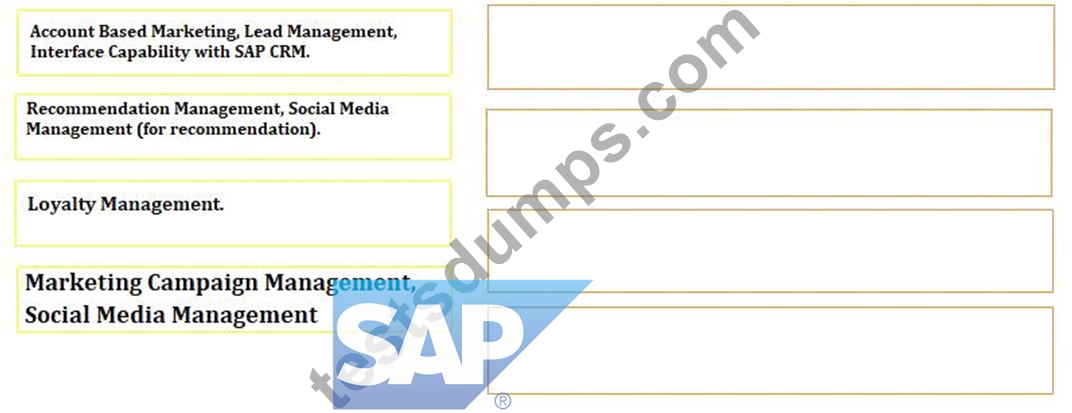
Answer:
Explanation: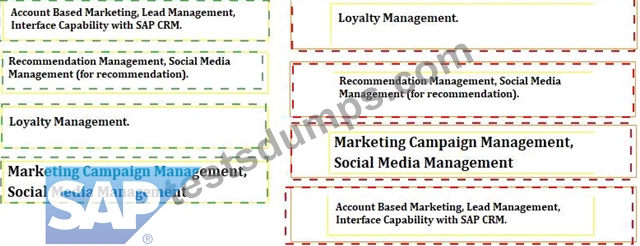
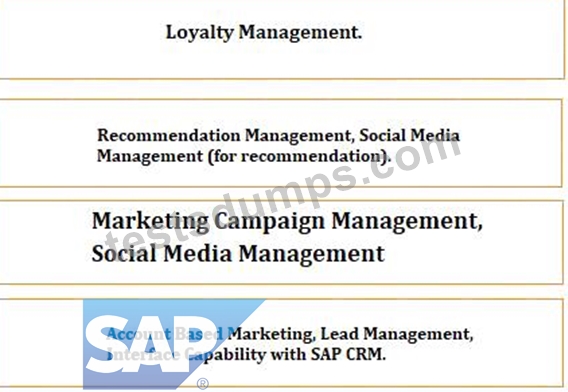
NEW QUESTION # 26
Which artifact from the SAP Reference Solution Architecture shows which data objects are exchanged between SAP application components in a given end-to-end scenario?
- A. SAP Data Object Diagram, which is available from SAP API Business Accelerator Hub (api.sap.com)
- B. SAP Data Flow Diagram, which is available from SAP API Business Accelerator Hub (api sap.com)
- C. SAP Data Component Diagram, which is available in SAP Signavio Process Explorer
Answer: B
Explanation:
The SAP Data Flow Diagram (DFD) is an artifact from the SAP Reference Solution Architecture that shows which data objects are exchanged between SAP application components in a given end-to-end scenario. The DFD uses a graphical representation to show the flow of data between different components of a system.
The SAP Data Object Diagram (DOD) is also an artifact from the SAP Reference Solution Architecture, but it does not show the flow of data between different components. The DOD shows the structure of data objects, including their attributes and relationships.
The SAP Data Component Diagram (DCD) is an artifact from SAP Signavio Process Explorer, which is a tool for modeling business processes. The DCD shows the different components of a system, including their relationships.
Therefore, the correct answer is option B.
Here is a table that summarizes the different artifacts and their purposes: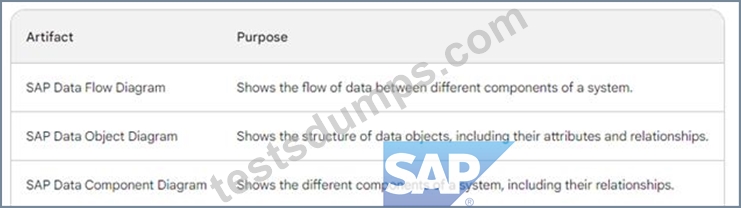
According to the SAP Reference Architecture Content: An Overview - Part 2 , the SAP Data Flow Diagram is an artifact that shows the flow of data through the SAP solution, from the source to the destination. It also shows which data objects are exchanged between the different components and services of the SAP solution, such as master data, transactional data, analytical data, or configuration data. The SAP Data Flow Diagram can help you to understand and communicate how data is created, transformed, and consumed in a SAP solution, and to identify and optimize the data integration points and dependencies.
The other options (A and C) are not correct for the artifact from the SAP Reference Solution Architecture that shows which data objects are exchanged between SAP application components in a given end-to-end scenario, because they either do not exist or do not show the data flow. For example:
Option A is not correct because there is no such artifact as SAP Data Object Diagram in the SAP Reference Solution Architecture content. The SAP API Business Accelerator Hub (api.sap.com) is a platform that provides access to SAP APIs, events, and related resources, but it does not provide any diagrams that show the data objects exchanged between SAP application components.
Option C is not correct because the SAP Data Component Diagram is not an artifact that shows the data flow, but rather an artifact that shows the main components and services that constitute the target application architecture, as well as their relationships and interactions. The SAP Data Component Diagram does not show which data objects are exchanged between the different components and services of the SAP solution. The SAP Signavio Process Explorer is a tool that helps you to model, analyze, and optimize business processes, but it does not provide any diagrams that show the data flow.
NEW QUESTION # 27
Tho Wanderlust CIO wants to focus loss on marketing strategy and planning, to instead prioritize marketing implement goals in mind to enhance number of leads generated:
* Run effective and highly visible campaigns (for example. on social media)
* Increase cross selling opportunities through online recommendation
AS the Chief Enterprise Architect Of Wanderlust. assisted by the SAP Enterprise Architects, you have been trying to re goals with the Business Process Modules, Segments and Activities in the Lead to Cash B2C Business Process Varia Business Architecture content repository (see graphic below).
What are relevant combinations Of business activities and goals based on the graphic below?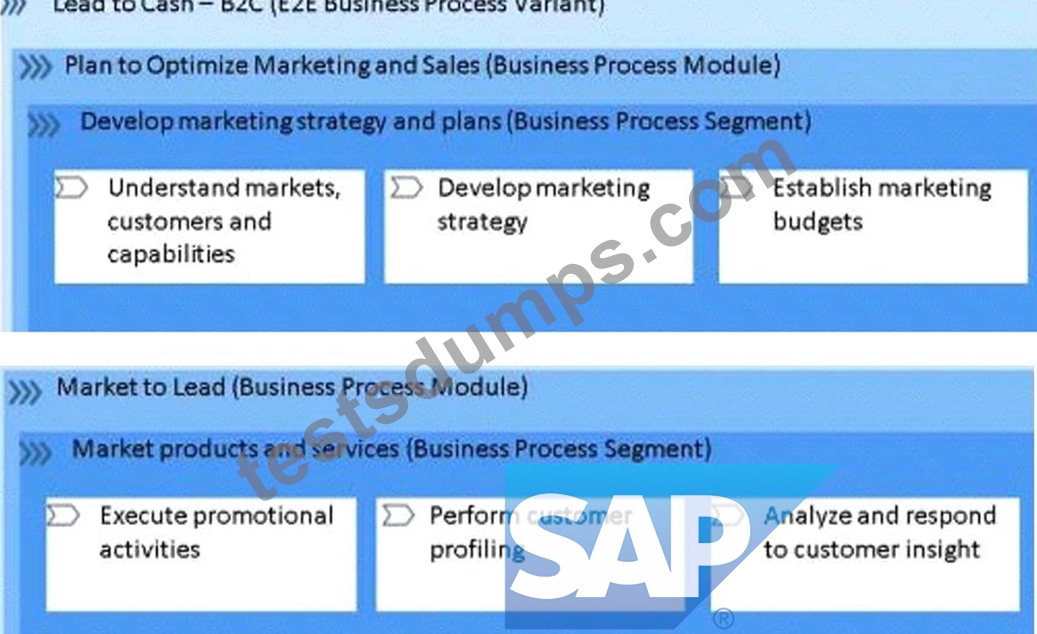
Note: There are 2 correct answers to this question.
See the Image
- A. Develop market strategy -Run effective and high visibility campaigns.
- B. Analyse and respond to customer insight- increase cross selling opportunities through online recommendations.
- C. Implement promotional activities-Run effective and high visibility campaigns.
- D. Design and mange a customer loyalty program- increase cross selling opportunities through online recommendations.
Answer: B,C
Explanation:
Explanation
Analyse and respond to customer insight is a business activity that is related to the Customer Insight segment of the Lead to Cash B2C Business Process Variant. This business activity can help Wanderlust to identify opportunities to increase cross selling through online recommendations.
Implement promotional activities is a business activity that is related to the Promotion segment of the Lead to Cash B2C Business Process Variant. This business activity can help Wanderlust to run effective and highly visible campaigns on social media.
The other two options, Develop market strategy and Design and mange a customer loyalty program, are not as relevant to the goals that Wanderlust is trying to achieve.
Develop market strategy is a business activity that is related to the Marketing Strategy segment of the Lead to Cash B2C Business Process Variant. This business activity is more focused on the overall marketing strategy of Wanderlust, rather than the specific goals of increasing cross selling or running effective campaigns.
Design and mange a customer loyalty program is a business activity that is related to the Customer Relationship Management segment of the Lead to Cash B2C Business Process Variant. This business activity is more focused on building long-term relationships with customers, rather than the specific goals of increasing cross selling or running effective campaigns.
Therefore, the best course of action is to focus on the Analyse and respond to customer insight and Implement promotional activities business activities in order to achieve Wanderlust's goals of increasing cross selling and running effective campaigns.
NEW QUESTION # 28
A custom web application developed with SAPUI5 and running on SAP Business Technology Platform uses large custom data objects deployed in a central data store (SAP HANA Cloud). The solution architect of the application is unsure about which tools to use for integration of this data from different SAP Sources into the central data store and asks you as the Enterprise Architect for guidance. Under which conditions is a data-oriented integration approach (Data Integration) preferable to other integration styles?
- A. If the data objects are built with data from different SAP and non-SAP sources that can be structured and unstructured, change with high frequency, and need to be cleansed, correlated and partly newly calculated.
- B. If the data objects are built with data from different SAP and non-SAP sources that can be structured and unstructured, change with high frequency, and need to be newly calculated.
- C. The data objects are built with data from different SAP and non-SAP sources that change infrequently and are available from REST and Message APIs (event-driven systems).
Answer: A
Explanation:
A data-oriented integration approach is optimal when dealing with diverse data sources and complex data requirements. This includes scenarios where the data is both structured and unstructured, changes rapidly, and needs significant processing such as cleansing, correlation, and partial recalculation. The advantage of this approach is that it centralizes data handling and transformation logic, allowing for more efficient data processing and integration into a central store like SAP HANA Cloud.
Reference = SAP's guidelines on data integration recommend this approach when handling large and complex data sets that require intensive processing and are sourced from a variety of SAP and non-SAP systems. It is supported by SAP's data management and integration tools that are designed to handle such complexity and frequency of change.
NEW QUESTION # 29
Which integration styles does SAP's Integration Advisory Methodology (ISA-M) cover in general?
- A. Cloud2Cloud/Cloud2OnPremise/Cloud2Cloud/User2On Premise/User2Cloud/Thing2On Premise/Thing2Cloud
- B. Ul Integration/Process Integration/Data Integration/Thing Integration.
- C. Process Integration/Data Integration/Analytics Integration/User Integration/Thing Integration.
Answer: B
Explanation:
The Integration Advisory Methodology (ISA-M) is a framework that helps organizations to design, build, and manage their integration landscape. ISA-M covers a wide range of integration styles, including:
Process Integration: This style of integration involves the integration of business processes across different systems and applications.
Data Integration: This style of integration involves the integration of data from different sources into a single data repository.
Analytics Integration: This style of integration involves the integration of data from different sources for the purpose of analytics.
User Integration: This style of integration involves the integration of user interfaces from different systems and applications.
Thing Integration: This style of integration involves the integration of things, such as sensors and actuators, with other systems and applications.
ISA-M also includes a number of other integration styles, such as event-driven integration, service-oriented integration, and enterprise application integration.
By covering a wide range of integration styles, ISA-M provides organizations with a flexible framework that can be used to meet their specific integration needs.
SAP's Integration Solution Advisory Methodology (ISA-M) is a framework that helps enterprise architects to define and execute an integration strategy for their organization. ISA-M covers five integration styles that represent different aspects of integration in a hybrid landscape. These integration styles are3:
Process Integration: This integration style enables end-to-end business processes across different applications and systems, such as SAP S/4HANA, SAP SuccessFactors, or third-party solutions. Process integration typically involves orchestrating or choreographing multiple services or APIs to achieve a business outcome.
Data Integration: This integration style enables data exchange and synchronization between different data sources and targets, such as SAP HANA, SAP Data Warehouse Cloud, or third-party databases. Data integration typically involves extracting, transforming, and loading (ETL) data to support analytical or operational scenarios.
Analytics Integration: This integration style enables data visualization and exploration across different data sources and targets, such as SAP Analytics Cloud, SAP BusinessObjects BI Platform, or third-party tools. Analytics integration typically involves creating dashboards, reports, or stories to provide insights and recommendations for decision making.
User Integration: This integration style enables user interaction and collaboration across different applications and systems, such as SAP Fiori Launchpad, SAP Jam, or third-party portals. User integration typically involves creating consistent and seamless user experiences that integrate multiple UI technologies and frameworks.
Thing Integration: This integration style enables device connectivity and management across different applications and systems, such as SAP IoT, SAP Edge Services, or third-party platforms. Thing integration typically involves connecting physical devices or sensors to the cloud or the edge and enabling data ingestion, processing, and action.
Verified Reference: 3: https://help.sap.com/docs/btp/architecture-and-development-guide-for-industry-cloud-solutions/runtimes-environments-and-programming-models
NEW QUESTION # 30
What are important factors of the SAP BTP. Cloud Foundry environment during runtime that you need to consider?
- A. CPU capacity and memory size of the application
- B. Programming language and buildpacks
- C. Number of users and API calls
Answer: A
Explanation:
In the SAP BTP Cloud Foundry environment, several factors are critical during runtime to ensure optimal application performance and scalability. The correct answer, A, highlights two fundamental aspects:
Programming language: This determines the specific buildpack to be used, as Cloud Foundry supports multiple programming languages through different buildpacks which provide framework and runtime support for applications.
Buildpacks: These are key components in the Cloud Foundry architecture that provide runtime and framework support necessary to build and deploy applications in various programming languages effectively.
These elements are crucial as they directly impact how applications are built, deployed, and run within the Cloud Foundry environment, influencing performance, compatibility, and scalability.
Reference:
SAP BTP Cloud Foundry documentation.
Buildpacks and programming language support in SAP BTP.
NEW QUESTION # 31
......
P_SAPEA_2023 Exam questions and answers: https://actualanswers.testsdumps.com/P_SAPEA_2023_real-exam-dumps.html
