A sense of fulfillment follows a certificate earned the honest way. TestsDumps handles the honest preparation for the Microsoft Agentic AI Business Solutions Architect exam: 109 practice questions, a written refund policy, and support around the clock.
Microsoft AB-100 Exam Syllabus Topics:
| Section | Weight | Objectives |
|---|---|---|
| Topic 1: Plan AI-powered business solutions | 25–30% | - Analyze requirements for AI-powered business solutions
|
| Topic 2: Deploy AI-powered business solutions | 40–45% | - Design ALM processes
|
| Topic 3: Design AI-powered business solutions | 25–30% | - Orchestrate configuration
|
AB-100 Exam FAQ: Quality, Price, and Policy
Microsoft recommends these training resources for the Microsoft Agentic AI Business Solutions Architect exam:
Follow the training with steady self-testing — the 109 practice questions from TestsDumps help you apply theory and fill any gaps the training leaves.
The official Microsoft Agentic AI Business Solutions Architect outline defines 3 domains. The leading three are Design AI-powered business solutions (25–30%), Plan AI-powered business solutions (25–30%), and Deploy AI-powered business solutions (40–45%). The full list is in the topics section above, and TestsDumps's 109 practice questions cover each one.
Online proctored or onsite at Pearson VUE test centers Register for the Microsoft Agentic AI Business Solutions Architect exam through these official channels:
After booking, TestsDumps delivers your practice questions within 1 minute — preparation starts the same day.
The Microsoft Agentic AI Business Solutions Architect exam contains 40–60 to complete within 100 minutes. Timed simulation in the TestsDumps Desktop Test Engine teaches that rhythm before exam day does.
TestsDumps issues a full refund if you take the Microsoft Agentic AI Business Solutions Architect exam within 60 days of purchase and do not pass. The policy does not apply if the exam is taken within 3 days of purchase, if the exam was never actually taken, or to free materials or expired orders, and the candidate name must match the payer name. Submit a scan of your enrollment slip and the official Score Report PDF within 2 days of the exam; claims are processed within 7 days. Alternatively, exchange for two free exam products of equal value and keep your original update service. Orders arrive by email within 1 minute — contact support if nothing arrives within 2 hours.
The AB-100 exam is a Microsoft certification exam validating the Microsoft Agentic AI Business Solutions Architect syllabus shown above. It belongs to these credential paths: Microsoft Certified: Azure AI Engineer Associate, Microsoft Certified: Power Platform Functional Consultant Associate, Microsoft Certified: Dynamics 365 Certified. Candidates in 2026 prepare for it with TestsDumps's 109 practice questions, available as a printable PDF, a Windows Desktop Test Engine, and an Online Test Engine — three versions of the same materials.
Recommended: experience designing AI solutions, knowledge of Dynamics 365, Power Platform, Copilot Studio, Azure AI Foundry; no mandatory prerequisites Since requirements change over time, confirm the latest on the official Microsoft exam page before scheduling.
The Microsoft Agentic AI Business Solutions Architect exam requires 700 (out of 1000) to pass, and registration costs $165 USD. A failed attempt means paying the same fee again — a readiness check with the TestsDumps engines before booking is the cheaper option.
Three versions of the same study materials: a printable, expert-prepared PDF with free demo download and instant access; a Desktop Test Engine for Windows with customizable simulation and timed modes that works offline; and an Online Test Engine for any browser on Windows, Mac, Android, and iOS with test history and performance review. All 109 practice questions are identical across versions. Every purchase includes 365 days of free updates, a 50% renewal discount afterward, and unlimited computer installations.
Microsoft Agentic AI Business Solutions Architect Sample Questions:
A company has a canvas app named App1 in a Microsoft Power Platform environment named Env1.
Env1 uses a customer-managed key for data encryption. App1 connects to multiple data sources to retrieve and update customer and order information.
You need to recommend a solution to add Microsoft Copilot components to Appl. The solution must NOT modify the current security or encryption configurations of Env1.
What should you include in the recommendation?
- A. Enable Copilot features for Env1.
- B. Move App1 to a new environment that uses Microsoft-managed keys.
- C. Duplicate App1 and republish the app in Env1.
- D. Modify the data sources of App1 to make them compatible with Copilot.
Correct Answer: B 🗳️
Explanation: Only visible for TestsDumps members. You can sign-up / login (it's free).
A company has Microsoft Power Platform development staging, and production environments. Each environment has its own Microsoft Dataverse tables and Azure Al Search index.
You are designing an application lifecycle management (ALM) process to deploy a Microsoft Copilot Studio agent between the environments.
The company has a Copilot Studio agent named Agent! in development. Agent1 uses the following grounding data sources:
* A Dataverse table named CustomerOrders
* An Azure Al Search index named customer-knowledge
You need to deploy Agent1 to production. The solution must ensure that the agent uses the production grounding data sources, minimizes downtime, and handles credentials and endpoints securely.
What should you include in the deployment package solution, and what should you reconfigure after the deployment? To answer, select the appropriate options in the answer area.
NOTE: Each correct selection is worth one point.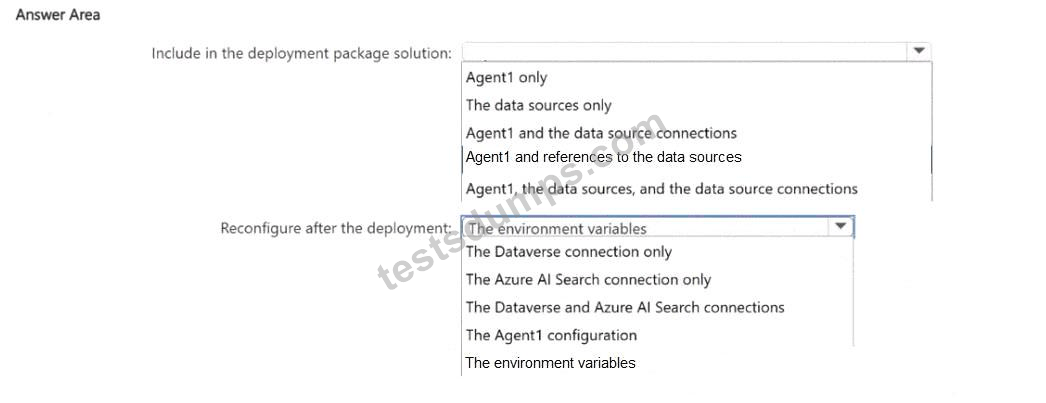
Correct Answer:
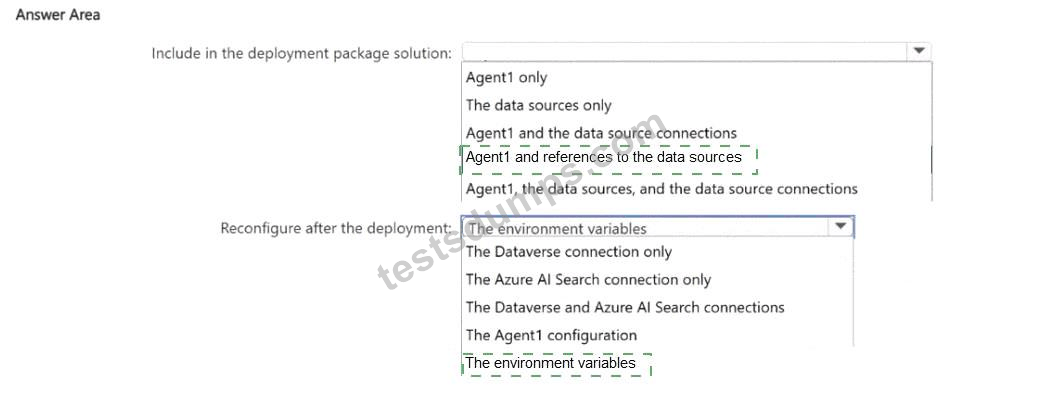
Explanation:
In a proper ALM deployment for Microsoft Copilot Studio across development, staging, and production, you should package the agent in a way that is portable across environments while avoiding hardcoded endpoints, indexes, table targets, or credentials.
Here, Agent1 uses:
a Dataverse table: CustomerOrders
an Azure AI Search index: customer-knowledge
Because each environment has its own Dataverse tables and Azure AI Search index, the deployment package should not carry over the development environment's live connections as fixed production settings. Instead, it should carry the agent and the references needed so the target environment can bind to its own production resources.
That is why the correct recommendation is:
Deployment package: Agent1 and references to the data sources
After deployment: Reconfigure the environment variables
Why this is correct:
Environment variables are the standard ALM-friendly way to externalize settings like:
endpoints
index names
table references
connection-related values
This supports secure handling of credentials and endpoints
It also helps minimize downtime, because production values can be switched cleanly after import without rebuilding the agent Why the other choices are weaker:
Agent1 only would omit needed source references
The data sources only would not deploy the actual agent
Agent1 and the data source connections risks carrying environment-specific connection bindings Agent1, the data sources, and the data source connections is too tightly coupled to the source environment and is not the best ALM design for secure cross-environment deployment Reconfiguring only Dataverse or only Azure AI Search is incomplete because both can vary by environment Reconfiguring Agent1 configuration is broader and less precise than using environment variables
A company has an Azure environment that supports multiple business units.
The company plans to implement an Al solution that will pertain sentiment analysis on customer product reviews. You need to evaluate the potential cost of the solution to support return on Al investment (ROAI) analysis. What should you use?
- A. Microsoft Fabric SKU Estimator
- B. Cost Management + Billing
- C. Azure Reservations
- D. Azure Monitor
Correct Answer: B 🗳️
Explanation: Only visible for TestsDumps members. You can sign-up / login (it's free).
A company has a customer order system that creates sales orders manually.
You need to design an Ai solution to automate the following tasks as part of the system:
* Save the order details to a database.
* Update the order status m the database.
* Extract the order details from an order file
* Prepare and send a confirmation email to customers.
The solution must minimize development effort and support intelligent automation and solution integration.
What should you include m the design?
- A. a Microsoft Copilot Studio agent that uses Microsoft Power Automate workflows
- B. a multi-agent solution that uses Microsoft Foundry Agent Service
- C. a workflow in Azure Logic Apps
- D. a multi-agent solution that uses the Semantic Kernel SDK
Correct Answer: A 🗳️
A company has an AI solution that uses a Microsoft Copilot Studio agent.
You need to monitor the agent ' s performance. The solution must meet the following requirements:
Monitor the agent ' s telemetry in near-real-time (NRT).
Download transcripts of full conversations.
Monitor the agent ' s usage and performance.
What should you use for each requirement? To answer, drag the appropriate options to the correct requirements. Each option may be used once, more than once, or not at all.
NOTE: Each correct selection is worth one point.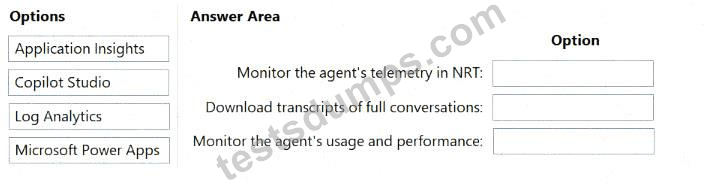
Correct Answer:
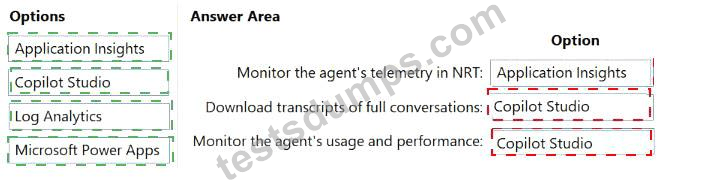
Explanation:
Monitor telemetry in NRT # Application Insights; Download transcripts of full conversations # Copilot Studio; Monitor usage and performance # Copilot Studio The correct mapping is:
Monitor the agent ' s telemetry in near-real-time (NRT) # Application Insights Download transcripts of full conversations # Copilot Studio Monitor the agent ' s usage and performance # Copilot Studio Why Application Insights is correct for NRT telemetry Application Insights is the right choice for near-real-time telemetry because it is built for operational monitoring of application events, traces, failures, latency, and runtime behavior.
For a Copilot Studio agent, Application Insights is used when you want fast visibility into:
request activity
errors and exceptions
latency trends
runtime traces
telemetry streaming for troubleshooting
From an AI business solutions perspective, this is essential for early detection of issues in production, especially when the agent supports customer or employee workflows.
Why Copilot Studio is correct for full conversation transcripts
Copilot Studio provides access to conversation/session-level analysis, including the ability to review and download full conversation transcripts.
This is the correct place to inspect:
what the user asked
how the agent responded
where the conversation failed
whether escalation occurred
what happened across the whole interaction
That makes it the best tool for transcript retrieval and investigation.
Why Copilot Studio is also correct for usage and performance
Copilot Studio includes built-in analytics for monitoring agent usage and performance, such as:
conversation volume
engagement
resolution trends
escalation behavior
answer quality and outcomes
This supports business-level performance monitoring and continuous improvement.
Why the other options are incorrect
Log Analytics
Log Analytics is useful for querying centralized logs, but it is not the best direct answer here for near-real- time Copilot telemetry or full conversation transcript download in this scenario.
Microsoft Power Apps
Power Apps is not the monitoring platform for Copilot Studio telemetry, transcripts, or usage/performance analytics.
Expert reasoning
Use this exam shortcut:
Near-real-time telemetry and operational tracing # Application Insights Conversation transcripts # Copilot Studio Agent usage and performance analytics # Copilot Studio
Viewing page 1 out of 22 pages.
Viewing questions 1-5 out of 109 questions.


 Nancy

 Rosalind

 Nathan
 Julian
 Hayden
 Woodrow

 Lucy
 Laura
 Lewis
 Evangeline
 Jill
 Dolores
 Doreen
 Mortimer